
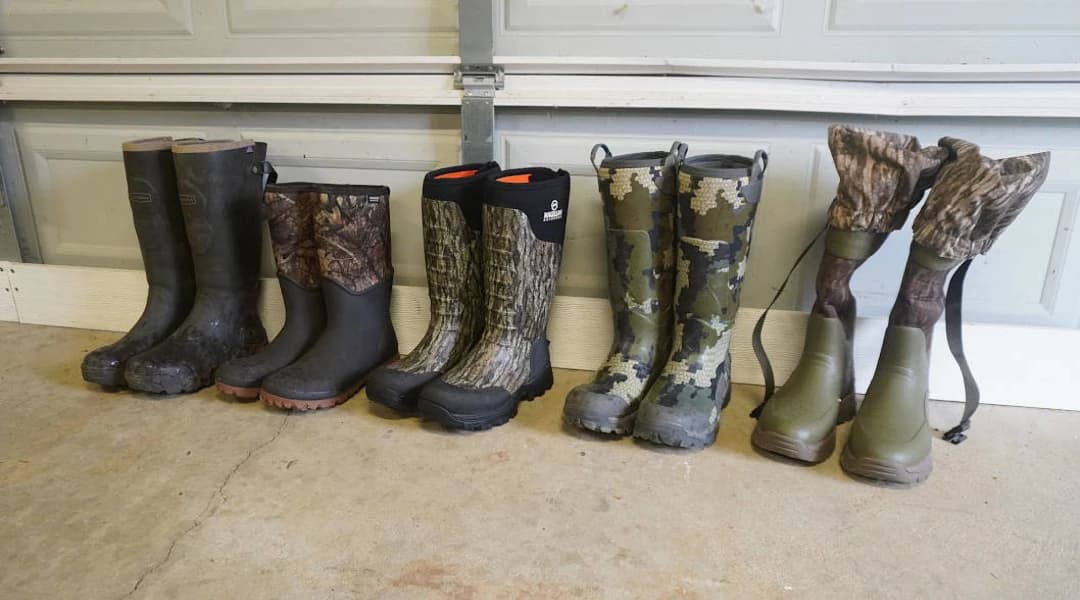
Every year, my hunting area seems to get soggier. Underground springs feed a constant supply of freshwater. With enough rain saturation, it sometimes gurgles…
Every year, my hunting area seems to get soggier. Underground springs feed a constant supply of freshwater. With enough rain saturation, it sometimes gurgles up from holes, flooding the entire area. I’d be hard-pressed to find a single location that is consistently dry throughout the year. Knowing this, it should be evident that rubber hunting boots are a key part of my gear arsenal.
Whether stalking whitetails in November or big Toms in April, I constantly need to keep my feet dry and comfortable. Over the years, I’ve tested many different brands and styles, always pursuing the perfect pair. I think I’ve found some of the best with these options.
How I Tested These Rubber Hunting Boots
Most of these boots I have owned for well over a year now. I’ve put plenty of miles on the tread as I’ve pursued whitetails, turkeys, and more. These boots were all subject to plenty of standing water and thick mud. I used these boots in every weather condition imaginable: snow and ice, rain, and the heat of summer. This helped me determine the type of terrain each tread pattern was best suited to traverse. It also helped me ensure the boots had no leaks when walking through standing water. Additionally, I considered the following factors in my decisions:
- Construction: Rubber hunting boots must be durable and last through multiple seasons. We noted any design flaws, although every pair we feature here deserves a look for hunters. Pairs of boots that weren’t durable didn’t make this list.
- Insulation: We noted the effectiveness of insulation in boots designed for cold weather conditions. Boots designed for cold weather were tested in temperatures as low as 15 degrees Fahrenheit with Merino wool socks. They weren't considered if the boots couldn’t keep my feet cold under those circumstances.
- Value: Some of the boots we tested are expensive. We thoroughly evaluated the materials and the longevity of each pair. In doing that, we wanted to answer whether hunters would get their money’s worth from a pricey pair of boots. We also wanted to ensure the materials used warranted the MSRP.
Considerations When Buying Rubber Hunting Boots
My part of southwest Michigan has an extremely damp climate, thanks to the lake effect weather across Lake Michigan. Therefore, I usually wear the tallest boots I can find. Some flooded spots in my favorite hunting areas are a foot or more deep year-round. Height is an essential consideration for any hunter, but it is just one factor. These are some other things to consider.
Sizing
In my experience, it’s usually best to size up one size when buying rubber boots. These things are rarely true to size. I wish more companies would make half-size options for their boots, but I don’t think there’s a market for it. Therefore, it’s best to prepare for needing a little extra wiggle room. This is another instance where it is vital to consider the thickness of the socks. Going up two sizes in cold conditions with thicker socks might be preferable. Again, I recommend investing in quality socks rather than wearing multiple pairs. It’s easier to put them on and take them off. Also, it’s a more accurate fit and less laundry in the long run.
Tread Pattern
One morning, I was walking to my stand with some less-than-optimal boots and slipped on the edge of a deep puddle. I ended up wet, and my shotgun ended up partially in the water. When I got home, it was not a fun cleaning session. Consider the type of terrain and mud when choosing a boot. Dense, complex tread patterns can hold dried, caked mud and debris, reducing their effectiveness and making them slippery.
Finding the ideal tread for your favorite hunting area may take some experimentation. If the mud in your area clumps easily, go for a more open pattern. Denser patterns work best in wet, slimy mud that doesn’t clump while dry.
Insulation
Most manufacturers now offer rubber hunting boots in insulated and uninsulated versions. Hunters in the south can likely get away with uninsulated boots for all applications. Even in colder temperatures, a good pair of Merino wool socks will do plenty to keep feet warm and dry. Whatever you do, don’t wear cotton socks with rubber hunting boots. Cotton does a horrible job of staying dry. I recommend Alpaca or Merino wool. These socks are more expensive but will vastly improve the experience of rubber boots. They also reduce odors.
Regardless of sock choice, hunters in northern states will likely need some insulation. Thinsulate and PrimaLoft are the two most popular forms used these days. I’ve used boots with both, and I can’t say one is better. Both seem to do their job well. What is more important is how much insulation there is in the boot. I’ve found 800 to 1,200 grams is more than adequate for most hunting here in the Midwest. Some of the coldest temperatures I hunt yearly are usually mid-teens. Remember that more insulation hurts breathability, so choose wisely.
The Best Rubber Hunting Boots
- Best Overall: KUIU HD Mud Boot
- Best Budget: Magellan Outdoors Swamp King
- Best Tall: Chêne Slouge
- Most Versatile: LaCrosse Alpha Evolution
- Best Warm Weather: Bogs Arcata
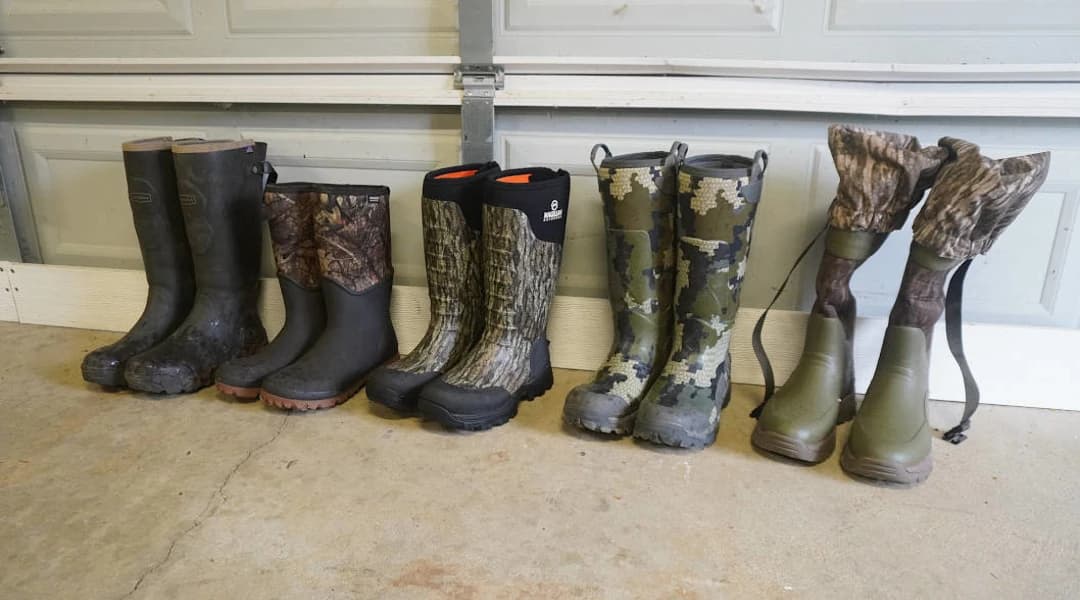
Best Overall: KUIU HD Mud Boot
- Sizes: 8 – 14 (Men’s)
- Weight: 4 Pounds, 10.6 Ounces
- Material: Neoprene, Vulcanized Rubber, EVA
**Pros
- Incredibly comfortable
- Lightweight
- Great in cold conditions
**Cons
- Price tag
Kuiu has stepped up its game over the last couple of years. Product quality has risen, and their HD mud boots are no exception. I wore these boots during Michigan’s firearms deer season last year, and never once had cold feet. The fleece liner and insulating neoprene did their job perfectly. These boots were incredibly comfortable straight from the box. Zero break-in was required. While I spent most of my time in a blind or treestand, I also wore these while shed hunting this year. It’s surprising how comfortable they are while hiking. That’s not the case with every boot of this style I’ve tested. The treads of the soles stand out here. My hunting area has a lot of thick mud that tends to clump in boots. However, that hasn’t happened with the HD mud boots. Nothing sticks to them, and the traction is excellent, even in slimy mud.
These are some of the best rubber boots I’ve ever worn. Kuiu put a lot of thought into the design. That becomes obvious from the small features like the kick-off tabs. It only takes me a second to remove these boots after the hunt. The main negative is that these boots are not cheap at $230. Coupled with a whole Kuiu outfit, they get expensive quickly. I also noticed it took a little elbow grease to wash some blood off after I harvested a buck last season. Other than that, I have almost no complaints. I’ve worn a lot of rubber boots over the years, but few that can match this quality. Kuiu has a winner with these.
Best Budget: Magellan Outdoors Swamp King
- Sizes: 7 – 14 (Men’s)
- Weight: 4 Pounds, 10 Ounces
- Material: Neoprene, Rubber
**Pros
- Surprisingly affordable
- Quality back zippers
- Made in the U.S.A.
**Cons
- More sizing options would be nice
There are plenty of pairs of cheap boots out there. I know because I’ve tried most of them. However, the Academy Sports house brand Magellan stands out from the rest. Hunters who catch a sale at the right time will only pay between $35 and $65 for a pair of these. That the bargain price does not reflect a diminished quality either. I tested two variants of these boots. One has a clinching strap on the back, while the other utilizes a zipper. Of the two, I prefer the newer, zipper version. Magellan used high-quality YKK zippers here, and the pull is nice and large. I had no issues gripping in cold conditions. The cinch strap works fine, but I discovered it is a weak point on the boot. I ended up tearing the material. It’s not a problem if you don’t use that as a leverage point while putting them on (like I did.) Fortunately, this didn’t affect the fit, as these boots seem sized slightly small. Buy up at least one size from normal. I wish there were half-sizes for these boots.
Other than a wish for more sizing options, these are solid boots. The tread patterns are effective, and I haven’t had any leaks with either pair. It often feels like hunting is becoming a rich person’s sport these days, given the rising cost of equipment. Thus, finding this quality gear at a sub-$100 price point was refreshing. I also love the variants offered in this lineup. There are insulated, uninsulated, and three different camo options. That makes these boots an excellent entry-level point for hunters on a budget.
Best Tall: Chêne Slouge
- Sizes: 6 – 14 (Men’s)
- Weight: N/A
- Material: 3mm Neoprene and Proprietary EVA
**Pros
- Awesome traction
- Excellent warranty
- Quality construction
**Cons
- Expensive
- Heavy
Chêne is primarily a waterfowl brand, but the Slough boots have excellent utility for other scenarios. Think of these as an alternative to a heavy pair of waders. There’s a standard 16-inch rubber boot used as the base. However, Chêne upped the versatility by tacking 12 inches of wader material to the top. That gives these boots waterproof qualities up to 28 inches. Simply put, these boots go places others wouldn’t dare. This isn’t a slapped-together wader/boots combo, either. The seams, stitching, and materials are top-notch. I didn’t have a single drop of water enter during my testing. They are surprisingly breathable given the materials. Anyone who hunts shallow flooded timber in warmer temperatures will find much to like here. These will be dynamite for early-season Teal hunts in the south. They are a superb wader alternative for warm weather.
These boots are expensive, but they are cheaper than some sets of chest waders. My only other complaint is that they are heavy. Other than that, there’s a lot to love here. The treads on the soles are excellent, and they handle the slop like a champ. These boots were made for the swamp. Additionally, the wader section rolls down to give them the functionality of a standard 16-inch mud boot. One could argue this is technically two sets of boots in one, adding to the value.
Most Versatile: LaCrosse Alpha Evolution
- Sizes: 6 – 15 (Men’s)
- Weight: 5.3 Pounds
- Material: Rubber, Neoprene, and EVA
**Pros
- Incredible quality
- Excellent warranty
- Quality construction
**Cons
- Expensive
- Heavy
I’ve been wearing LaCrosse’s Alpha Evolution boots a lot lately. These were on my feet when I harvested my turkey this year. I tested the non-insulated version and had no issues with cold feet when coupled with Merino wool socks. That was despite some 45-degree mornings in the blind. These boots feel like a natural extension of my feet. The Vibram XS Trek treads do an excellent job in especially slimy or thick mud. I wore these while shed hunting a few times and was impressed with the durability. Thorns and sharp sticks bounce off the exterior of these boots like they’re nothing. They were excellent for spring turkey, but I can see their applications in waterfowl, deer, and more. LaCrosse makes a version insulated with 800 grams of PrimaLoft insulation for hunters who need severe cold protection.
Hunters can expect to pay a premium price for these boots, at $300. Part of those costs likely come from the fact that they’re assembled here in the U.S.A. These boots are also a little heavier than the other options I tested. They wore me down faster than other options if I had to do excessive walking. However, my feet stayed incredibly dry and comfortable the whole time. They also breathe well, making the uninsulated version an excellent option for warmer climates. This is an excellent investment for hunters who want to buy one pair for all seasons.
Best Warm Weather: Bogs Arcata
- Sizes: 7 – 13 (Men’s)
- Weight: 3.6 Pounds
- Material: 5mm Neo-Tech Waterproof Insulation and EVA
**Pros
- Incredibly breathable
- Treads are incredible in deep mud
- Ridiculously lightweight
**Cons
- Slightly short
- Not great on ice
Bogs is a lesser-known brand that has built a surprisingly great boot with the Arcata. This may be the most breathable pair of boots that I own. It was the best pair I tested in that regard. I usually use this pair for my trail camera checks during the dog days of summer. It’s the only pair that doesn’t leave my feet sweating profusely during that chore. Bogs aren’t joking when they market the moisture-wicking capabilities of these boots. I also love the treads of these boots. They are deep and act like mud tires for your feet. They churn up thick mud and soft bottoms like they aren’t there. This is the pair I turn to when I know things will be exceedingly messy.
These are some of my shortest boots at around 14 inches. Thus, they are best suited for scenarios with shallow water. It would be nice if Bogs made a 17-inch version. Bogs advertise these boots for icy conditions, but I don’t buy it. The outsole feels too hard and is too tall. Additionally, they breathe too much in cold conditions. I could feel the coolness of the water while wading. It feels great in warm conditions, but will lead to cold feet in cool ones. Subsequently, these are best for summer boots. However, they are also an excellent option for hot southern duck and dove hunts without excessive flooding.
FAQs
**Q: Are rubber boots good for hunting?
A: Rubber boots are an excellent option for hunting, especially in wet environments. They are perfect for waterfowlers. However, these boots are also a fantastic option for big game because they won’t leave as much scent behind. It makes it easier to stay undetected in the woods.
**Q: What are the cons of rubber boots?
A: The biggest con to rubber hunting boots is that most can be sweaty in hot weather. The thick material isn’t always conducive to breathability, even though I’ve found exceptions like the Bogs Arcata. Another con is that some pairs aren’t as comfortable as standard boots. They aren’t a good option for long hikes in rugged terrain.
**Q: Do rubber boots leave ground scent?
A: Contrary to what some manufacturers want consumers to believe, all boots leave some form of ground scent. However, rubber boots are likely much better with scent because they won’t absorb smells like leather. In my experience, rubber boots usually pass the smell test better than my leather options. The sealed nature of these boots also means they do a better job of smell containment than anything with laces.
Conclusion
Manufacturers keep improving the quality of rubber hunting boots every year. Kuiu’s HD mud boots are my current favorites from a comfort and versatility standpoint. My runner-up is the LaCrosse Alpha Evolution for its incredible construction quality and excellent traction. However, all the boots I tested here are excellent for many different styles of hunting.
Written by
The Inside Spread Team
Contributing writer at The Inside Spread. Passionate about sharing hunting knowledge and conservation efforts.
Comments
No comments yet. Be the first to share your thoughts.
More in hunting
Pre-Rut Whitetail Guide: How to Hunt Bucks Right as They Go On Their Feet
A complete pre-rut whitetail guide covering scrape lines, rub lines, scent-checking behavior, rattling tactics, and how to adjust your setup as bucks shift off food and onto their feet in October.

Early Season Whitetail Guide: What Deer Are Doing Right Now (And How to Cash In Before the Rut)
A complete early season whitetail guide covering deer behavior, food source patterns, buck sighting tactics, and the best time to harvest a doe before the rut kicks in.
What to Look for When Walking Hunting Land for the First Time
On the first walk of hunting land, look past acreage. Judge food, water, cover, and neighboring properties the way deer actually use the landscape.

Best Trail Camera Deals This Week: Cellular Cameras, Feeders & Bows Worth Buying
This week's Academy Sports hot deals—cellular trail cameras, feeders, and archery gear worth buying, plus a few we'd skip.