
California Salmon Came Back After Three Years Gone. Then Anglers Caught the Season Shut in Weeks.
California salmon fishing returned in 2026, but fast Chinook catches closed the Klamath zone and shortened Fort Bragg. Here is what anglers need to know.
For three straight years, there was no meaningful salmon season in California. None for the commercial fleet that had worked these waters for generations, and in two of those years, none for the weekend angler either. The Chinook that built the culture and economy of the Northern California coast had crashed so badly that the only responsible thing to do was stop fishing for them entirely.
This spring, they came back.
After the complete recreational closures of 2023 and 2024 and a token six-day season in 2025, California opened real recreational ocean salmon fishing again in 2026—and for the first time in three years, the commercial fleet got to go back to work too. It was the news every salmon angler on the West Coast had been waiting for. Forecasts for key salmon runs had improved enough to support fishing again.
Then, in a matter of weeks, anglers caught the northern seasons right back into closure.
On July 28, 2026, NOAA Fisheries closed the remaining August dates in the Klamath Management Zone and slashed the Fort Bragg area's August season down to a nine-day window. The reason was not another collapse. It was the opposite problem: anglers hit the Klamath harvest guideline faster than expected and left Fort Bragg with only a small share of its allocation.
This is what a fragile recovery looks like in real time. It is a more complicated—and more important—story than a simple “closure” headline suggests.
Planning a trip? These fisheries are managed in season and can change quickly. Check the CDFW Ocean Salmon Fishery Information page immediately before leaving the dock.
What just happened: the July 28 closures explained
Let us start with exactly what changed, because if you are planning a salmon trip to Northern California in August, this affects you directly.
On July 28, NOAA Fisheries took in-season action to close or modify ocean salmon fishing for portions of California's north coast. The Klamath Management Zone—the ocean waters between the California/Oregon border and 40°10′ North latitude—has no remaining spring or summer fishing dates. In the Fort Bragg Management Area, between 40°10′ North latitude and Point Arena, the season is scheduled to reopen August 1 and run only through August 9. The rest of the August dates originally scheduled for Fort Bragg have been canceled.
The numbers behind those closures tell the real story. In the Klamath Management Zone, preliminary estimates showed that 3,968 Chinook salmon were taken by 4,830 anglers aboard charter vessels and private skiffs—reaching the area's recreational harvest guideline of 3,900 fish. The guideline was met. Under the rules governing this fishery, that ends the remaining season.
In the Fort Bragg area, 4,352 Chinook had been taken by 6,208 anglers as of the announcement, leaving just 748 fish in the area's 5,100-fish harvest guideline when the season reopens August 1. Managers expect that remaining cushion to be gone by the August 9 closure date. Recent catch rates and angler effort made the math simple: at the current pace, Fort Bragg's anglers could hit their cap in about nine days.
For the coast south of Point Arena, the picture is more open. The San Francisco Management Area is scheduled to resume August 1 and run through August 31 or until its harvest guideline of 34,900 Chinook is met. The Monterey Management Area remains open through August 31 or until its 21,800-Chinook guideline is met. A separate fall ocean salmon season is scheduled to begin in September with a shared 20,000-Chinook harvest guideline for open portions of the Monterey and San Francisco areas.
If you are fishing salmon out of a Northern California port in August, in short: the Klamath zone is closed, Fort Bragg offers a narrow early-August window, and the San Francisco and Monterey areas provide the larger remaining summer opportunities.
How we got here: three years of no salmon
To understand why anglers filling a quota in a few weeks is actually good news, you have to understand how dark the preceding years were.
California's salmon fishery did not decline gradually. It fell off a cliff. In 2023 and 2024, both recreational and commercial ocean salmon fishing were completely closed off the California coast—a total shutdown of a fishery that supports coastal economies, tribal communities, and a fishing culture stretching back generations. In 2025, recreational anglers got just six open days statewide. The commercial fleet stayed tied to the dock for a third consecutive year.
The cause was a compounding disaster. California's severe multi-year drought devastated the freshwater rivers where salmon spawn and where juvenile fish rear before heading to sea. Low, warm water in the Sacramento and Klamath river systems—the two engines of California's Chinook production—reduced juvenile survival and adult returns. Layer in decades of habitat loss, dams, water diversions, and changing ocean conditions, and the result was a population that could not support harvest.
For coastal communities from Fort Bragg to Half Moon Bay, the closures were an economic gut punch. Charter operations that depended on salmon seasons lost their primary product. Tackle shops, fuel docks, motels, and restaurants in salmon ports felt the absence of the anglers who normally filled them every summer. The commercial fleet—the men and women who put wild California Chinook on restaurant plates—went years without its signature fishery.
The salmon closures of 2023 through 2025 were not regulatory overreach. They were a last-resort response to a genuine population emergency. That context matters enormously for understanding what is happening now.
Why fishing returned in 2026
The 2026 reopening happened because the two river systems that drive California's salmon populations showed real, measurable improvement.
CDFW reported significant improvements in Sacramento River fall-run Chinook and Klamath River fall-run Chinook—the two runs at the heart of the California ocean fishery. When forecasts for those stocks are strong enough, managers can provide harvest while meeting conservation requirements. In 2026, for the first time in years, those forecasts supported meaningful recreational and commercial opportunities.
Better freshwater conditions after the drought and years of habitat work helped produce the improved outlook. California also launched a long-term salmon strategy in 2024 covering habitat restoration, migration barriers, hatchery modernization, and climate resilience.
The removal of four Klamath River dams, completed in 2024 as the largest dam-removal project in U.S. history, reopened access to hundreds of miles of habitat. That work is a major long-term opportunity for Klamath salmon, but the timing matters: adult Chinook available to the 2026 ocean fishery largely began their life cycle before the dams came down. Dam removal should shape future generations more than it explains this year's immediate rebound.
The result is a fishery that, while nowhere near its historic peak, improved enough to reopen. CDFW Director Charlton H. Bonham described the comeback as evidence of what is possible when state and federal partners, tribes, sport anglers, commercial fishermen, and conservation groups work together toward salmon recovery. The return of a California commercial salmon season after three closed years represents years of coordinated and difficult work paying off.
Why the season closed so fast: how in-season management works
Here is the part that trips people up. If the salmon came back, why did the season close so quickly?
The answer is a management approach called in-season management, and understanding it is key to seeing why the rapid closures are a feature, not a failure.
In 2026, CDFW implemented in-season management in both commercial and recreational fisheries specifically to ensure that catches of rebounding salmon stocks do not exceed carefully set seasonal harvest guidelines. Rather than setting a fixed season and hoping harvest stays sustainable, managers set a hard number—a harvest guideline—for each zone. Once anglers reach that number, the zone closes regardless of the calendar.
This is fundamentally different from setting a block of dates and letting every scheduled day run. That approach can work when populations are robust enough that a full season's harvest is clearly sustainable. It is riskier for a fishery in early recovery, where the difference between sustainable fishing and a setback may be a relatively small number of fish.
In-season management lets fishery scientists thread that needle. They open the season, monitor catches through dockside sampling and reporting, and take action when harvest approaches the guideline. It is a system built to allow fishing on rebuilding stocks without letting fishing undo the progress.
So when the Klamath zone reached its 3,900-fish guideline and closed, that was not the system failing. It was the system working as designed. Anglers received their allocation. The stock retained its protection. The rebuilding process continues.
That does not make it any less frustrating for the angler who booked an August charter out of Eureka and now finds the Klamath zone closed. But the closure is what makes fishing on a rebuilding stock possible in the first place. The alternative would risk overshooting the guideline and setting the fishery back. Nobody who lived through the 2023 and 2024 closures wants to return there.
What this means for anglers right now
If you are planning a Northern California salmon trip in the coming weeks, here is the practical breakdown.
The Klamath Management Zone is closed for the remainder of the spring and summer season. If your plans involved fishing out of Crescent City or Eureka for ocean salmon, those plans need to change.
The Fort Bragg Management Area is scheduled to open August 1 and close August 9, or earlier if managers take additional in-season action. If you want to fish Fort Bragg salmon, the window is narrow. Book early, go early, and have a backup plan.
The San Francisco Management Area is scheduled to reopen August 1 and continue through August 31 or until the 34,900-Chinook guideline is met. The Monterey Management Area is scheduled through August 31 or until its 21,800-Chinook guideline is met. These central and south coast areas have larger harvest guidelines and offer the main remaining summer opportunities.
A separate fall ocean salmon fishery is scheduled to open September 1 in designated portions of the San Francisco and Monterey areas under a shared 20,000-Chinook fall guideline. If you miss the summer window, the fall fishery may provide another opportunity.
The single most important habit for California salmon anglers in 2026 is simple: check before you go. Because the fishery is under in-season management, an open area can close on short notice once its guideline is approached. CDFW maintains current catch estimates and regulations on its Ocean Salmon Fishery Information page and operates an Ocean Salmon Regulations Hotline at 707-576-3429.
Before you burn a tank of fuel and a vacation day, confirm the area you are headed to is still open. For broader licensing and trip-planning information, see our California fishing guide.
The bigger picture: a cautious win worth protecting
It would be easy to write this story as another chapter in the endless saga of fishing restrictions—anglers getting shut out, seasons cut short, access denied. That framing would be lazy and wrong.
The truth is more hopeful and more instructive. California salmon were in genuine crisis. The system responded with hard closures that nobody enjoyed but that were biologically necessary. Conditions improved, habitat work continued, and salmon forecasts responded. Now, in 2026, there are enough fish to support fishing again—and the in-season management system is rationing that harvest to protect a recovery that took years of work to achieve.
That is conservation working. Not conservation as a slogan, but conservation as a functioning system: monitor the resource, restrict harvest when the science demands it, restore habitat, and reopen access as populations rebuild. The rapid July action is the system doing what it is supposed to do—allowing anglers back on the water while trying to ensure that the comeback does not get loved to death in its first meaningful season back.
There is a lesson here that applies well beyond California. The North American conservation system works when managers have the tools and the will to make hard decisions, and when the fishing and hunting community understands that short-term restrictions are sometimes the price of long-term abundance. The angler who accepts a closed Klamath zone in 2026 is making the same bargain intended to produce salmon in future seasons.
California's salmon are not recovered. They are recovering. The difference matters, and the careful management of the 2026 season—closures and all—will help determine whether the fish that came back this year are still here for the next generation of anglers.
For now, the fleet is back on the water where fishing remains open, the salmon are biting, and after three years of empty seasons, that is worth celebrating—even if the window is shorter than anyone would like.
Frequently asked questions about California's 2026 salmon season
Why did California close part of its ocean salmon season in July 2026?
NOAA Fisheries closed the remaining Klamath Management Zone dates and shortened the Fort Bragg season on July 28, 2026, because anglers reached or approached the recreational harvest guidelines for those areas. The Klamath zone reached its guideline of 3,900 Chinook, with a preliminary estimate of 3,968 fish taken by 4,830 anglers. Fort Bragg was projected to reach its 5,100-fish guideline by August 9.
Is California salmon fishing completely closed in 2026?
No. The Klamath Management Zone's remaining spring and summer dates are closed. Fort Bragg is scheduled for August 1 through August 9. The San Francisco and Monterey management areas retain August opportunities subject to their harvest guidelines, and a separate fall season is scheduled for portions of those areas.
Why was California salmon fishing closed during the previous three years?
Recreational and commercial ocean salmon fishing were completely closed in 2023 and 2024 because Chinook abundance could not support harvest. Recreational anglers received only six open days in 2025, while commercial fishing remained closed for a third consecutive year. Drought, poor river conditions, habitat loss, and changing ocean conditions all contributed to weak returns.
Why did California salmon forecasts improve?
Fishery managers reported significant improvements in Sacramento River fall-run and Klamath River fall-run Chinook abundance. Better freshwater conditions and years of restoration contributed to the improved outlook. The 2024 Klamath dam removals should provide important long-term benefits, but they occurred too recently to be the main cause of adult salmon available in 2026.
What is in-season management for salmon fishing?
In-season management sets a specific harvest guideline for each area, monitors catches during the season, and closes or modifies fishing dates as the guideline is reached. It allows limited harvest on rebuilding stocks while keeping catches within conservation limits.
How do I know if a California salmon area is open before fishing?
Always check the CDFW Ocean Salmon Fishery Information page immediately before fishing or call the Ocean Salmon Regulations Hotline at 707-576-3429. In-season rules can change on short notice.
Did commercial salmon fishing return to California in 2026?
Yes. Commercial ocean salmon fishing returned in 2026 after three consecutive closed years. It operates under vessel-based trip limits, seasonal harvest limits, and in-season management.
When does California's fall salmon season open in 2026?
The fall recreational fishery is scheduled to begin September 1 in designated portions of the San Francisco and Monterey management areas under a shared 20,000-Chinook harvest guideline. Dates remain subject to in-season action.
Sources
- California Department of Fish and Wildlife: Ocean Salmon Fishery Information and July 28 in-season update
- California Department of Fish and Wildlife: Ocean Salmon Fishing Comeback Continues
- California Department of Fish and Wildlife: Ocean Salmon Harvest Tracking Tools
- California Department of Fish and Wildlife: 2026 Ocean Salmon Sport Regulations
- Pacific Fishery Management Council: Salmon Management
- NOAA Fisheries: West Coast Salmon Fisheries
- California Natural Resources Agency: California Salmon Strategy
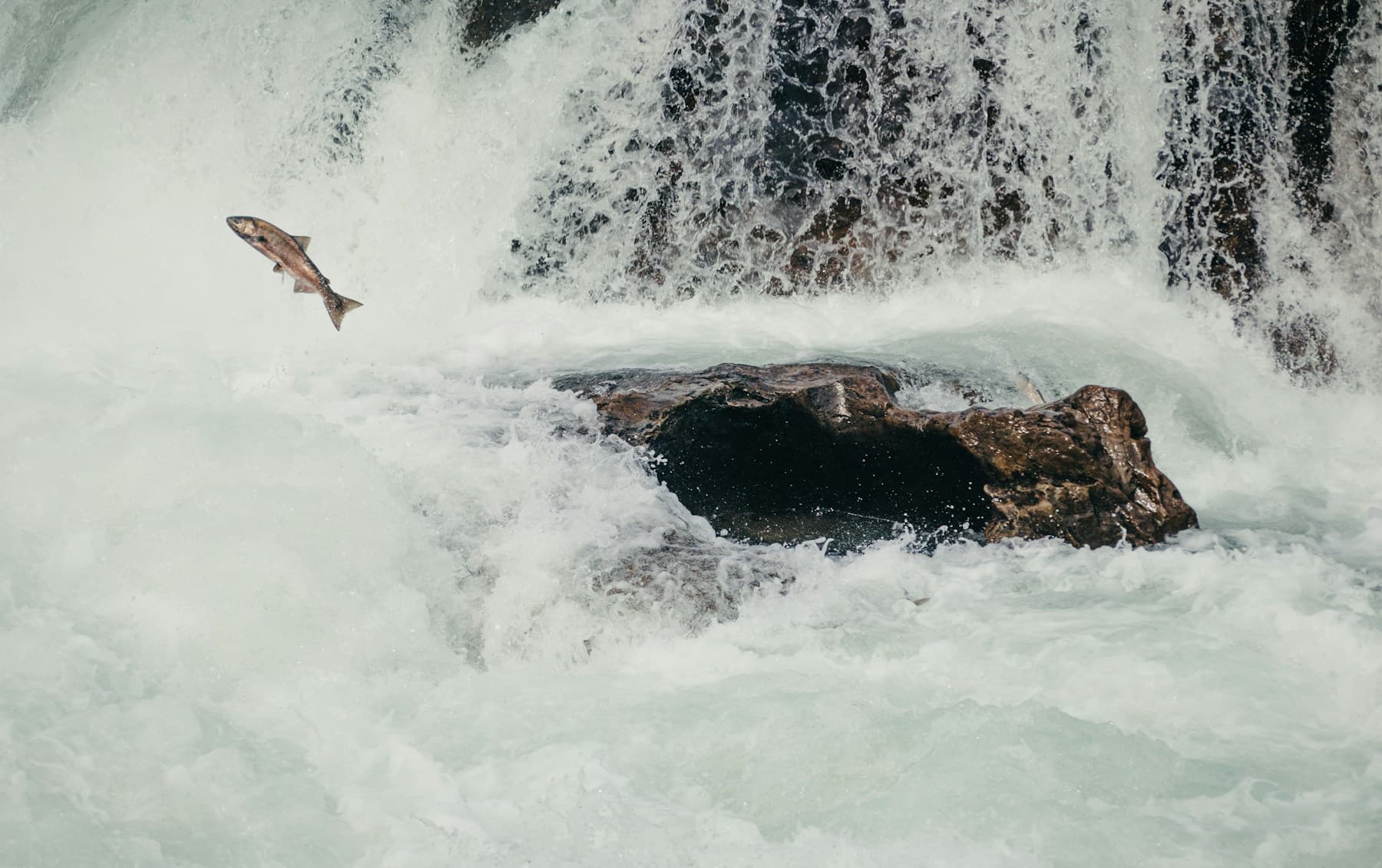
- Unsplash: Salmon leaping upstream through a powerful waterfall, Shana Van Roosbroek
The Inside Spread covers hunting, fishing, shooting, and conservation. We donate 10% of profits to wildlife conservation.
Written by
The Inside Spread Staff
The Inside Spread staff reports on hunting, fishing, shooting, and conservation news with a focus on practical information for sportsmen and women.
Comments
No comments yet. Be the first to share your thoughts.
More in fishing
These Idaho Sturgeon Are Older Than the Anglers Chasing Them. Sixteen Just Died, and Fish and Game Had to Act.
Idaho closed sturgeon fishing on part of CJ Strike after 16 white sturgeon died. Closure dates, water-quality causes, and why the population matters.
Best Spinning Reels Under $100: Top Budget Picks for 2026
Best spinning reels under $100 for 2026—Daiwa Exceler LT, Pflueger President XT, Penn Pursuit IV, Shimano Sedona FJ, and Daiwa Crossfire LT for bass, trout, and light salt.
They Caught a $6.5 Million Marlin. Then They Gave It to Science. Here's What Was Found Inside.
Marlin Fever's 919.9-pound Big Rock record marlin held a sailfish and wahoo in its stomach—findings NC State CMAST researchers call unprecedented in 24 years. Final payout, science partnership, and FAQ.
An 18-Year-Old Just Caught a 919-Pound Marlin and Could Walk Away With $6.2 Million. Here's the Full Story.
Connor Daniel hooked a 919.9-pound blue marlin aboard Marlin Fever at the 2026 Big Rock Tournament—breaking the 68-year record and chasing a projected $6.2M payout. Full story, leaderboard, and FAQ.