
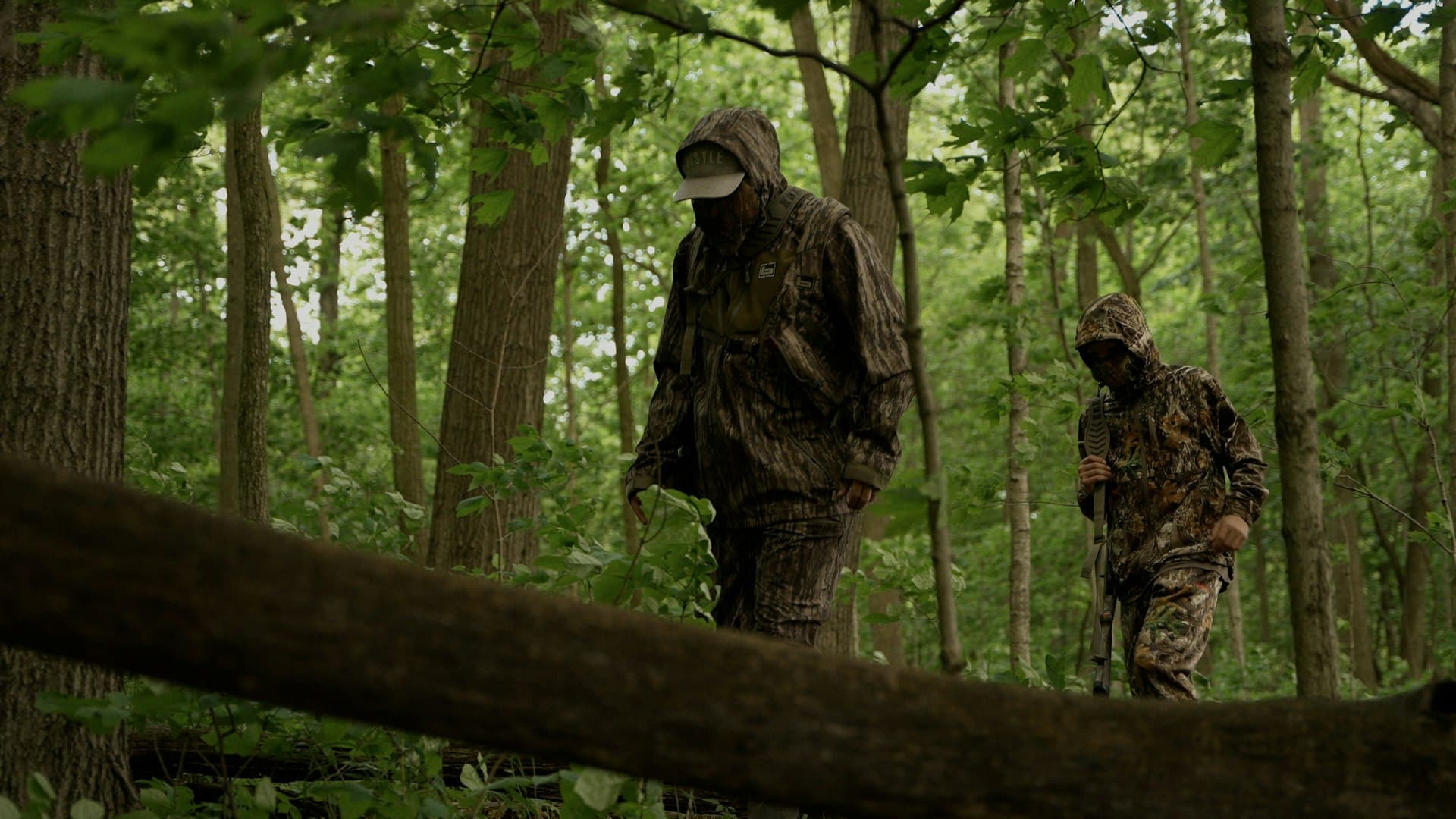
On the first walk of hunting land, look past acreage. Judge food, water, cover, and neighboring properties the way deer actually use the landscape.
The first time I walk a piece of hunting land, I'm primarily looking for three things: food, water, and cover.
Those are basic needs, but simply checking three boxes doesn't tell you much. The real question is what kind of food, water, and cover are available, where they are located, and how they compare with what the surrounding properties provide.
- Food: native browse, mast, fruit, and crops—not just a visible food plot
- Water: ponds, creeks, ditches, wetlands, and how scarce that water is nearby
- Cover: thick, messy structure at deer level, not just a pretty mature timber stand
Deer don't care where one property ends and another begins. Understanding how a tract fits into the larger landscape can tell you far more than acreage alone. If you are evaluating ground in this part of the country, pair this walk with the North Carolina hunting guide so seasons and access sit next to habitat.
Start With Food — But Look Beyond Food Plots
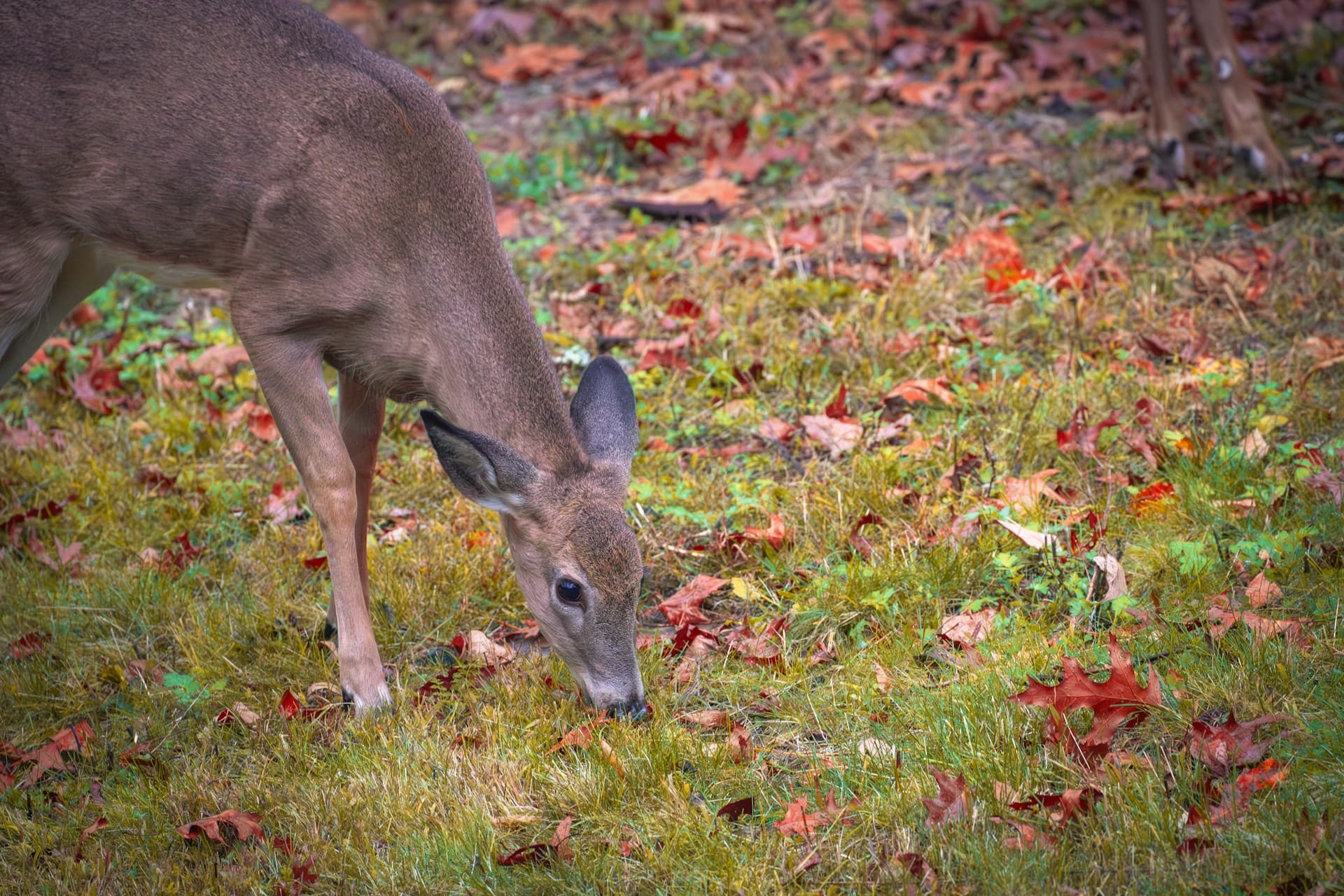
When most hunters think about deer food, they tend to picture food plots, agricultural fields, or acorns.
Those certainly matter. But they are only part of the picture.
White-tailed deer are browsers. They eat agricultural crops and some grasses, but much of their natural diet consists of forbs and leafy browse: the leaves, buds, tender stems, and growing tips of woody plants and vines. Acorns, fruits, mushrooms, and other seasonal foods fill in the diet as they become available.
That means one of the most useful things you can do while walking hunting land is learn to recognize what deer are already eating.
Pay attention to browse pressure.
Sometimes you'll walk through the woods and find vegetation that almost looks like somebody bush-hogged it at knee height, except there is obviously no way a tractor ever made it into that spot. Look closer. There is a good chance deer have been repeatedly browsing those plants.
Try to identify what they are hitting.
Here in the Southeast, one of the plants I pay attention to is greenbrier. It's a thorny vine that deer absolutely hammer. In heavily browsed areas, I'll sometimes find long greenbrier vines with hardly a leaf left within reach of a deer. The leaves start showing up again once the vine climbs high enough into the trees, and many of the lower growing tips have been nipped off.
That tells me something useful.
Not just that deer have passed through, but that the area is producing something they repeatedly want to eat.
If you later decide a planted field belongs in the mix, August food plot timing for whitetails is a practical next step—not a substitute for reading the native forage already on the ground.
Agricultural Fields Matter, but So Does Everything Around Them
Nearby agriculture can obviously affect deer movement.
Corn and soybeans can provide an enormous amount of food when they are available, and deer will readily use those fields. But I wouldn't dismiss a wooded property simply because the neighbor has hundreds of acres of crops.
Deer need more than one food source, and what is available changes throughout the year.
A tract with good native browse, mast-producing trees, fruiting plants, edge habitat, and young vegetation may complement the agricultural ground next door rather than compete with it.
That is an important distinction when evaluating hunting land.
You're not necessarily trying to provide more of everything than the neighbors. Sometimes the better opportunity is providing something the neighboring properties are missing.
Acorns Can Be Fantastic — and Sometimes Too Abundant
Hunters love finding acorn-producing oaks, and for good reason.
Acorns are an important high-energy food during the portion of the year when they are available. But they are still seasonal. Deer depend heavily on browse, forbs, soft mast, crops, and other foods during the rest of the year.
There is also a difference between good deer habitat and a good place to kill a deer.
If there is one heavily producing oak in an area with limited mast, that tree can concentrate deer movement and create an obvious hunting opportunity.
If you're standing in 100 acres of mature hardwoods and every oak around you is raining acorns, the deer may have no reason to visit the particular tree where you hung your stand.
There is plenty of food. It just isn't concentrated.
So when I find oaks, I don't simply think, Great, acorns. I want to pay attention to which oaks are dropping acorns, and when. Different species will drop acorns at different times, and one tree may not drop acorns every year.
I also want to know where those trees are in relation to bedding cover, travel routes, openings, and competing food sources.
Where Is the Water?
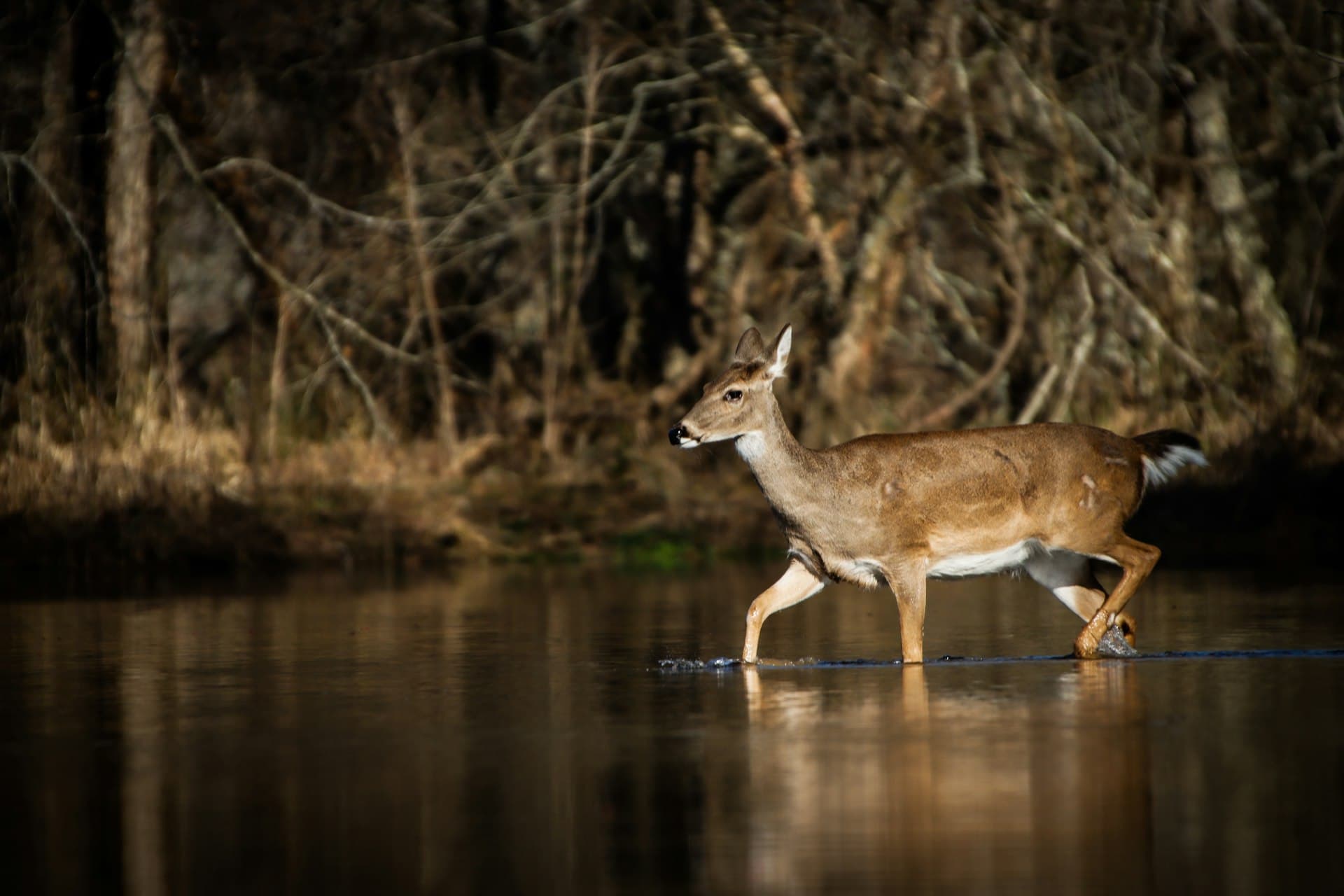
Water is usually easier to evaluate.
Look for ponds, creeks, rivers, ditches, wetlands, springs, and other places that consistently hold water. Even temporary water sources can be used by deer when conditions are right.
Then ask a second question:
What other water is available nearby?
A creek running through your tract may be useful, but it also likely crosses neighboring properties. What differentiates your property from the neighbors? How can you make your water source more attractive?
On the other hand, a reliable water source surrounded by otherwise dry ground may become a much more important part of local deer movement.
If a property lacks water, that doesn't necessarily make it poor hunting land. Water is one of the easier habitat components to add in many situations. Depending on the property, that might mean a small pond, a wildlife watering trough, or a rain-catchment system feeding a tank or basin.
The point isn't that every hunting property needs a pond, creek, or river.
It needs reliable water somewhere within the landscape deer are using.
Good Cover Often Looks Messy
Cover is where people sometimes misjudge a property.
A beautiful mature forest with big trees and a clean, open understory is pleasant to walk through. It may also offer relatively little food or security cover at deer level.
A nasty thicket that catches your clothes, scratches your arms, and makes you wonder why you left the trail can be a different story.
In the Southeast, deer commonly use dense young forests, vines, shrubs, regenerating timber, and other thick vegetation for both browse and security. Young pine stands, for example, can provide dense low cover along with blackberry and other deer browse.
Cover will look different elsewhere. It may be native grassland, cattails, brush, young timber, standing crops, or another vegetation type that allows deer to break up their outline and disappear.
When I'm walking a property, I like finding places where a deer can vanish.
If the tract is mostly open ground, there may be opportunities to create that structure with native warm-season grasses, shrubs, trees, or simply by allowing portions of the property to grow differently.
And if the property already has thick cover, think carefully before cleaning it up simply because it looks messy.
Sometimes the mess is the habitat.
For a Southeast example of how food, forest structure, cover, and land-management practices work together, this guide to wildlife habitat management in Coastal North Carolina goes deeper into those relationships.
Then Stop Looking at the Property
Once I've gotten a feel for the food, water, and cover on the tract, I want to know what is happening around it.
This matters especially on smaller properties.
A deer's home range can cover hundreds of acres, and some bucks use substantially larger areas. Mississippi State University telemetry research, for example, found a median annual home range of about 860 acres among the bucks studied, with tremendous variation between individual deer.
Your 40 acres may therefore represent only a small portion of a particular deer's world.
That isn't necessarily a huge disadvantage.
Look at aerial imagery. Walk the boundaries where appropriate. Pay attention while driving the surrounding roads. Figure out what the neighbors are providing.
Maybe the property next door is almost entirely mature timber, and offers limited food or cover at the deer level.
Maybe another neighbor has agricultural fields, but has no water source.
Maybe there is a large cutover nearby providing tremendous amounts of browse and bedding cover.
Maybe a creek bottom creates a natural travel corridor through several properties.
The objective isn't to duplicate everything around you. It is to figure out where your property fits.
If surrounding properties already provide abundant food but poor security cover, improving bedding and escape cover on your tract may make sense.
If you have thick bedding cover surrounded by relatively poor food sources, improving forage may have more value.
Good habitat management works with the surrounding landscape instead of pretending your property exists by itself.
That neighborhood-scale view also shapes how you hunt later. A 90-day early archery plan is a lot more useful once you know which food sources, edges, and travel routes actually belong to this landscape.
Hunting Pressure Can Matter More Than Acreage
The last thing I want to understand is hunting pressure.
This is harder to see from vegetation alone.
Who hunts the surrounding properties? How frequently? How do they hunt? Where are their stands? Are people constantly riding ATVs through the woods? Are neighboring properties part of heavily hunted clubs? Are they running dogs? Is there nearby ground where deer receive very little pressure?
Those questions can dramatically change how I view a property.
I would much rather hunt a well-managed 40-acre tract bordering lightly pressured sanctuary-type ground than assume a 140-acre tract is automatically better simply because it has another hundred acres attached to it.
Around here, you could easily have a situation where that larger property has dog-running clubs on both sides of it. The acreage looks great on paper. The hunting dynamics may be completely different once the season opens.
That doesn't necessarily make heavily pressured land unhuntable, but that pressure belongs in the equation.
The First Walk Is About Understanding the Landscape
When I walk hunting land for the first time, I'm not expecting to have the property figured out by the time I leave.
I want to know where deer can eat, where they can drink, where they can feel secure, and how those resources are arranged.
Then I want to zoom out.
What are the neighboring properties providing? What are they missing? Where is the hunting pressure coming from? Where might deer naturally move as they travel between resources?
Tracks, trails, beds, rubs, and scrapes can tell you that deer have been there.
Understanding why they are there is more useful.
Once you understand that, you can start figuring out how the property should actually be hunted—and what, if anything, needs to be changed.
Frequently Asked Questions
What should I look for when walking hunting land for the first time?
Start with food, water, and cover, then ask what kind of each exists, where it sits, and how it compares with neighboring properties. Acreage matters less than how the tract fits the larger landscape deer already use.
- Identify native browse and mast, not only plots and crop fields
- Map water on the tract and on adjoining ground
- Look for thick cover at deer level, even if it looks messy
Why isn't a food plot enough when evaluating deer hunting land?
White-tailed deer are browsers. Plots, crops, and acorns matter, but much of the year they eat forbs and leafy browse. Browse pressure on plants such as greenbrier can tell you more than a planted field alone.
How important is water on a hunting property?
Deer need reliable water somewhere in the landscape they use, not necessarily a pond on every tract. A scarce, consistent source can concentrate movement; missing water is often easier to add than missing cover or forage.
Does more acreage always mean better hunting?
No. Hunting pressure, neighboring sanctuaries, dog clubs, and how food and cover are arranged can outweigh raw acreage. A well-managed 40 acres next to lightly pressured ground can hunt better than a larger pressured tract.
How big is a typical buck home range?
Mississippi State University Deer Lab telemetry found a median annual home range of about 860 acres among adult bucks studied, with huge individual variation. A 40-acre tract is often only a slice of a deer's world.
Sources
- Mississippi State University Extension. Understanding Buck Movement: How, When, and Why Bucks Navigate the Landscape (Publication P3927). Median annual home range among adult bucks studied was about 860 acres.
- Salt & Soil Realty. Wildlife Habitat Management in Coastal North Carolina.
- TopSphere Media. "Two people in camouflage walk through the woods." Unsplash, unsplash.com/photos/LbeoGo2RObc.
- Krieger, Jason. "A deer grazing on grass in a wooded area." Unsplash, unsplash.com/photos/1A7RKwsJAWo.
- Kemelmakher, Alla. "A deer walking across a body of water." Unsplash, unsplash.com/photos/7iHEltkiBfY.

Written by
Carroll Harrod
Carroll Harrod is a North Carolina landowner, hunter, homesteader, and Journeyman Beekeeper with a particular interest in wildlife habitat, conservation, forestry, and practical land management. He owns and manages rural land in Eastern North Carolina and writes from firsthand experience working with habitat improvement, agriculture, hunting land, and long-term land stewardship. He is also the founder of Salt & Soil Realty Group and is known as "The Homesteading Realtor."
Comments
No comments yet. Be the first to share your thoughts.
More in hunting
Pre-Rut Whitetail Guide: How to Hunt Bucks Right as They Go On Their Feet
A complete pre-rut whitetail guide covering scrape lines, rub lines, scent-checking behavior, rattling tactics, and how to adjust your setup as bucks shift off food and onto their feet in October.
Early Season Whitetail Guide: What Deer Are Doing Right Now (And How to Cash In Before the Rut)
A complete early season whitetail guide covering deer behavior, food source patterns, buck sighting tactics, and the best time to harvest a doe before the rut kicks in.
Best Trail Camera Deals This Week: Cellular Cameras, Feeders & Bows Worth Buying
This week's Academy Sports hot deals—cellular trail cameras, feeders, and archery gear worth buying, plus a few we'd skip.
A Corrections Officer Spent Years Poaching Oregon's Big Game. It Cost Him His Career, $114,000, and Every Hunting Right He Had for Life.
Oregon banned Christopher Matson from hunting for life and fined him $114,000 after a multi-county poaching case. Sentence, charges, and why it matters.