
250 Years of America, and Hunters and Anglers Built the Greatest Wildlife Conservation System on Earth. Here's the Proof.
On America's 250th birthday—a history of the North American Model, Pittman-Robertson, the Duck Stamp, and five species comebacks funded by hunters and anglers…
Two hundred and fifty years ago, a group of men in Philadelphia signed their names to a document that changed the world. They declared, among other things, that the people of this new nation were endowed with certain unalienable rights — that government existed to serve the people, not the other way around, and that the land and its abundance belonged to everyone who called it home.
They could not have known that embedded in those principles was the philosophical foundation for the most successful wildlife conservation system in human history.
This Fourth of July, while the fireworks trace arcs over lakes and rivers and fields where Americans are fishing and camping and raising the next generation of hunters and anglers, it is worth pausing to say what too rarely gets said plainly: the wildlife abundance that defines the American outdoors did not happen by accident. It did not emerge from environmental organizations based in cities. It was not written into existence by bureaucrats in Washington. It was built, dollar by dollar and acre by acre, by hunters and anglers who loved what they were losing and chose to pay to save it.
That story is 250 years in the making. It is the most American conservation story ever told.
A continent that nearly hunted itself empty
Before we can understand what hunters and anglers built, we need to understand what was being destroyed. Because by the late 1800s, the American continent was in genuine ecological crisis — and the people who caused it were the people who eventually stopped it.
The passenger pigeon, once the most numerous bird in North America with flocks estimated in the billions that darkened skies for days as they passed, was shot and netted for market by the millions. The last one, a female named Martha, died in the Cincinnati Zoo in 1914. Gone. Permanently. Not recoverable at any price.
The American bison, which once numbered 30 to 60 million animals on the Great Plains — herds so vast that early explorers described them as a single living carpet stretching to the horizon — was reduced to fewer than 1,000 individuals by 1890. The U.S. Army had participated in systematic slaughter campaigns. Commercial hunters killed millions for hides and tongues, leaving carcasses to rot across the prairie. Indigenous peoples who had depended on the buffalo for everything — food, shelter, clothing, spiritual practice — watched their world collapse along with the herds.
The white-tailed deer, which today is so common it grazes in suburban backyards from Maine to Texas, hit rock bottom in 1890 when the U.S. Biological Survey estimated the entire national population at 300,000 animals. Indiana killed its last deer in 1893. Ohio's deer were effectively gone by 1900. States across the entire eastern United States reported their deer populations at or near zero.
Wild turkeys, which had existed in numbers estimated at 10 million before European settlement, were absent from 18 of their original 39 states by the early 1900s. The population nationally had collapsed to somewhere between 30,000 and 200,000 birds. Wildlife experts of the era believed the species might not survive the century.
Market hunting — the commercial slaughter of wildlife for sale as food and fashion — had stripped the continent in barely two generations. There were no bag limits, no seasons, no licenses, no enforcement, no accountability. The market decided what was worth killing, and the market had no mechanism for valuing what would no longer exist tomorrow. The Dust Bowl and the Great Depression compounded the collapse, draining wetlands that waterfowl depended on and pushing desperate Americans to harvest whatever they could find.
By the turn of the 20th century, it was hunters and anglers — the same community whose excesses had contributed to the crisis — who looked at what was happening and decided it had to stop. They organized. They lobbied. They proposed laws that restricted their own activities. They volunteered to pay taxes and fees into conservation funds. They did this not because someone made them, but because they understood something that took the broader conservation movement decades to acknowledge: you cannot love something and watch it disappear.
That understanding is the beating heart of everything that came next.
The Public Trust: wildlife belongs to everyone
In 1842, the U.S. Supreme Court established a legal principle in the case of Martin v. Waddell that would become the philosophical cornerstone of North American wildlife conservation: wildlife is held in trust for the public by the government. Not owned by individuals. Not the exclusive province of wealthy landowners as it was in Europe, where hunting had historically been the privilege of the aristocracy. Held in trust, on behalf of all Americans, to be managed for the benefit of present and future generations.
This was a radical idea. In England, in France, in most of the Old World, game animals belonged to whoever owned the land. The common man had no legal right to hunt them. The poacher was a criminal not because he was depleting a shared resource but because he was stealing from a lord.
America said no. In this country, the deer does not belong to the man who owns the field it grazes in. It belongs to the people. And the government's job is to manage it on their behalf.
That doctrine — the Public Trust Doctrine — laid the legal foundation for everything the American conservation movement would eventually build. It meant that wildlife management was a public responsibility, not a private one. And it meant that the question of who pays for that management was a question that would eventually have to be answered by the people who benefited from wildlife most directly — hunters and anglers.
They answered it voluntarily. That is the part of the story that gets lost in the modern conservation debate.
Teddy Roosevelt and the men who saw what was coming
Theodore Roosevelt was 23 years old when he first traveled to the Dakota Badlands in 1883, ostensibly to hunt bison. He arrived too late. The great herds were already gone. What he found instead was a landscape being stripped bare, a frontier being consumed faster than it could regenerate. What he felt in that moment shaped the rest of his life and, through it, the American landscape for the next century and beyond.
Roosevelt came back from the Badlands a changed man. He returned east and, with fellow sportsman and naturalist George Bird Grinnell, founded the Boone and Crockett Club in 1887 — an organization of big game hunters dedicated to the conservation of American wildlife and wild places. The Boone and Crockett Club was not an environmental organization in any modern sense. Its members were hunters. Elite ones, certainly, but hunters. Men who had held rifles and seen firsthand what was being lost.
The Club lobbied successfully for the creation of the first federal wildlife protection legislation, the National Park Protection Act of 1894. It pushed for the establishment of forest reserves under the Forest Reserve Act of 1891. It was instrumental in creating the first National Wildlife Refuge at Florida's Pelican Island in 1903, where plume hunters were decimating colonial nesting birds for the fashion industry. Roosevelt designated that refuge by executive order when Congress refused to act. When a congressman asked him where he got the authority to do it, Roosevelt's response was characteristically blunt: he asked whether there was a law preventing it. When told there was not, he signed the order.
By the time Roosevelt left the presidency in 1909, he had created 51 federal bird reserves, four national game preserves, 150 national forests, 18 national monuments, and five national parks — a total of approximately 230 million acres of protected federal land. No president before or since has done more for the American landscape in a single term.
But Roosevelt understood something that some of his conservation heirs have forgotten: protection without funding is a promise without a mechanism. You could draw lines on a map all you wanted. Without money to manage the land, enforce the laws, and restore the species, the lines were just lines.
The funding mechanism would come from hunters and anglers, and it would come in stages over the following decades. Each stage was built by the sporting community, for the sporting community — and for everyone who benefited from the wildlife that community was fighting to save.
1900: The Lacey Act — the first line of defense
The first major federal wildlife law wasn't about habitat. It was about commerce. The Lacey Act of 1900, sponsored by Iowa Congressman John Lacey — himself an avid outdoorsman — banned the interstate transport of illegally taken wildlife. It was the legal mechanism that killed market hunting by killing its economic engine. If you couldn't ship the carcasses across state lines to the restaurants and milliners of New York and Chicago, the slaughter wasn't profitable. If it wasn't profitable, it stopped.
The Lacey Act is often overlooked in conservation histories because it isn't glamorous. It didn't set aside land or establish refuges. It simply cut the money supply that was funding the destruction of American wildlife. But without it, every subsequent conservation achievement might have been undone by continued commercial exploitation.
Hunters and anglers pushed for it. Their organizations lobbied for it. Their political allies passed it. And the commercial wildlife trade, which had been operating openly and at scale for generations, effectively collapsed within a decade.
1918: The Migratory Bird Treaty Act — protecting birds across borders
Migratory birds don't recognize international boundaries, which means any serious effort to protect them requires international cooperation. The Migratory Bird Treaty Act of 1918, ratified under a treaty with Canada, established federal protections for hundreds of species of migratory birds — prohibiting their hunting, capture, killing, or sale without federal authorization.
The Act was controversial at first. States' rights advocates argued that wildlife management was a state responsibility. The Supreme Court disagreed in Missouri v. Holland (1920), upholding the treaty and the Act as a valid exercise of federal authority. The principle was established: migratory wildlife that crossed state and national borders could be managed at the federal level.
For waterfowl hunters specifically, the Migratory Bird Treaty Act established the federal framework for duck and goose seasons — the structure of federal frameworks, daily bag limits, and possession limits that waterfowl hunters still operate under today. It wasn't a restriction hunters resented. It was a structure hunters helped build because they understood that without it, the ducks and geese they hunted would disappear.
1934: The Duck Stamp — a $1 conservation miracle
By the early 1930s, American waterfowl were in catastrophic decline. The Dust Bowl had desiccated the Prairie Pothole Region — the shallow lakes and wetlands of the Dakotas, Minnesota, and southern Canada that serve as the breeding ground for the majority of North American ducks and geese. An estimated 100,000 square miles of wetlands had been drained for agriculture in the decades after World War I. Waterfowl populations were crashing.
Jay Norwood "Ding" Darling, a nationally syndicated Pulitzer Prize-winning political cartoonist, avid duck hunter, and director of the Bureau of Biological Survey, had a simple idea: make waterfowl hunters pay for the habitat their sport depended on. Not through taxation imposed on unwilling citizens, but through a conservation stamp that hunters would purchase voluntarily as a license to pursue the birds.
On March 16, 1934, President Franklin Roosevelt signed the Migratory Bird Hunting Stamp Act — the Duck Stamp Act. The first stamp cost one dollar. Ding Darling designed it himself. Ninety-eight cents of every dollar went directly to wetland conservation.
It was a small stamp with enormous consequences.
Since 1934, sales from Federal Duck Stamps have raised more than $1.3 billion to conserve more than 6 million acres of wetlands habitat — making the Federal Duck Stamp one of the most successful conservation revenue programs in history. Every one of those acres was purchased with a dollar that a hunter chose to pay voluntarily. No birdwatcher was taxed. No non-hunter contributed against their will. Waterfowl hunters looked at what they were losing and opened their wallets to save it.
More than 300 national wildlife refuges have been created or expanded using Federal Duck Stamp dollars. Wetlands acquired with Duck Stamp funds have also enabled the National Wildlife Refuge System to conserve in perpetuity thousands of small wetlands and grasslands in the Prairie Pothole Region, totaling over 3 million acres organized into 38 wetland management districts. Those wetlands don't just benefit ducks. They purify water. They reduce flooding. They provide habitat for hundreds of non-game species. They deliver billions of dollars in ecosystem services to communities that have never heard of the Duck Stamp.
One stamp. One dollar, then five, then fifteen, then twenty-five. Ninety-two years of voluntary payments from hunters who loved ducks enough to pay for the water where they lived.
1937: The Pittman-Robertson Act — the greatest conservation funding law ever passed
Three years after the Duck Stamp, Congress passed an act that would ultimately dwarf every other conservation funding mechanism in American history.
Senator Key Pittman of Nevada and Congressman Willis Robertson of Virginia sponsored the Federal Aid in Wildlife Restoration Act — known ever since as the Pittman-Robertson Act — which redirected an existing 11 percent federal excise tax on firearms and ammunition away from the general Treasury and into a dedicated Wildlife Restoration Fund to be distributed to state wildlife agencies for habitat acquisition, research, and restoration.
The genius of Pittman-Robertson was that it didn't create a new tax. It redirected an existing one. Manufacturers already paid it. Hunters buying rifles and ammunition already contributed to it. The Act simply ensured that those dollars went to wildlife rather than general government operations.
And then it required states, as a condition of receiving those funds, to use all hunting license revenues exclusively for wildlife management — closing the loophole that had allowed state governments to raid license fee revenues for unrelated purposes.
The results were transformational. Through self-imposed excise taxes on hunting, shooting, archery and angling equipment, and a tax on boating fuels, hunters, recreational shooters, and anglers have generated approximately $25.5 billion for wildlife and habitat conservation since 1937. Pittman-Robertson and Dingell-Johnson revenues comprise, on average, more than 75% of a state fish and wildlife agency's annual budget, according to the Association of Fish and Wildlife Agencies.
Twenty-five and a half billion dollars. Not from general taxpayers. Not from environmental organizations. From hunters buying guns and ammunition, anglers buying rods and reels, and the sporting goods industry that serves them — paying a tax they voluntarily supported because it went to wildlife.
As a result, animal populations that were once threatened or in danger of extinction — like buffalo, beavers, elk, deer, pronghorn, turkeys, and wood ducks — are now flourishing. "I cannot overstate the abundance, distribution and occurrence of wild birds and mammals on the continent were significantly changed by this act," said Tom Decker, branch manager for Communications, Analysis and Partnerships of the Wildlife and Sport Fish Restoration Program for the U.S. Fish and Wildlife Service. "Without the funding and these restoration projects, there wouldn't be any animals in some areas."
In 1950, the Dingell-Johnson Act extended the same excise tax model to fishing equipment — 10 percent on fishing tackle, rods, reels, lures, and accessories — directing those funds to state fisheries programs, fish hatcheries, and aquatic habitat restoration. The first national fish hatchery was established in 1872 on the McCloud River in California, and by 2026, the Fish and Wildlife Service manages 70 national fish hatcheries that release an estimated 223 million fish, mussels, and amphibians annually.
Anglers pulling trout from a cold mountain stream. Bass fishermen launching before dawn on a reservoir. Fly fishers wading an Appalachian creek. Every one of them benefits from an infrastructure of habitat, stocking, and management that was built and continues to be funded by the people who fish.
Five comebacks that prove the system works
The North American Model of Wildlife Conservation — the Public Trust Doctrine, the license structure, Pittman-Robertson, the Duck Stamp, the Lacey Act and Migratory Bird Treaty Act — is not a theory. It is a track record. Here are five species whose stories are the proof.
The White-Tailed Deer: from 300,000 to 30 million
While white-tailed deer currently number somewhere in the range of 30 million to 35 million, at the turn of the 20th century there were as few as 300,000 whitetails across the entire continent — just 1 percent of the current population. Indiana killed its last deer in 1893. Rhode Island, Connecticut, Maryland, West Virginia, New Jersey, Ohio, Kentucky, Tennessee, Indiana, Illinois, Iowa, Kansas, Missouri, and Nebraska all counted their whitetail herds at or near zero.
The recovery began with the Lacey Act cutting off market hunting, continued with state-level season closures and restocking programs, and accelerated dramatically after Pittman-Robertson funding allowed state agencies to hire biologists, acquire habitat, and implement scientific management. By 1965, when Kansas reopened its deer season, every state east of the Rocky Mountains had become a deer hunting state again.
Today, regulated hunting is the primary tool that keeps deer populations in ecological balance. Hunters do not just consume this resource — they fund its management and provide the only effective check on a population that, without them, would strip forests, devastate agriculture, and fill highways with collision statistics.
The Wild Turkey: from 30,000 to 7 million
By the 1930s, wild turkeys were nearly wiped out, with their numbers dwindling to an estimated 30,000 in the entire United States. Gone entirely from 18 of their original 39 states. Wildlife experts of the era debated whether the species would survive.
Once nearly wiped out and absent from more than half the United States, wild turkeys have made an astonishing recovery — from just 200,000 birds in the 1930s to more than 7 million today. Once extinct in 18 states, they now roam in 49 states, including many areas where they hadn't been seen in over 100 years.
The mechanism was cannon-netting — a technique developed in the 1950s that used explosive nets to safely trap wild turkeys for relocation — combined with Pittman-Robertson funding for state restoration programs and the founding of the National Wild Turkey Federation in 1973, which channeled private hunter dollars into habitat and reintroduction work. Hunters did this. The NWTF was founded by hunters, funded by hunters, and staffed by hunters who spent decades walking the woods to bring back a bird that was almost gone.
The American Bison: from fewer than 1,000 to 500,000
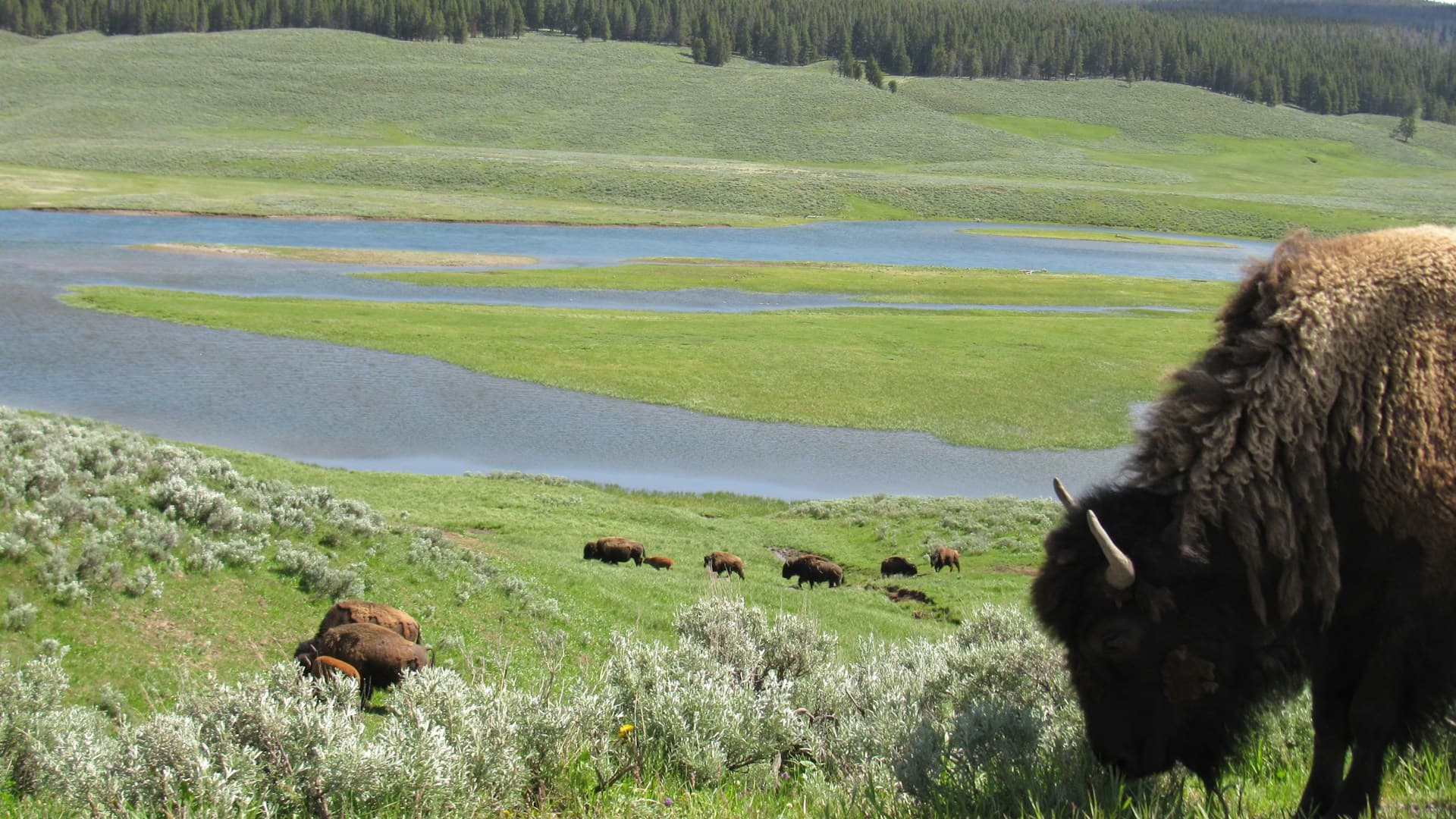
The bison story is the most dramatic of all American wildlife recoveries and the most painful to describe. Once numbering in the tens of millions across North America's grasslands, American bison were hunted to near extinction in the late 19th century, with fewer than 1,000 individuals remaining by 1900.
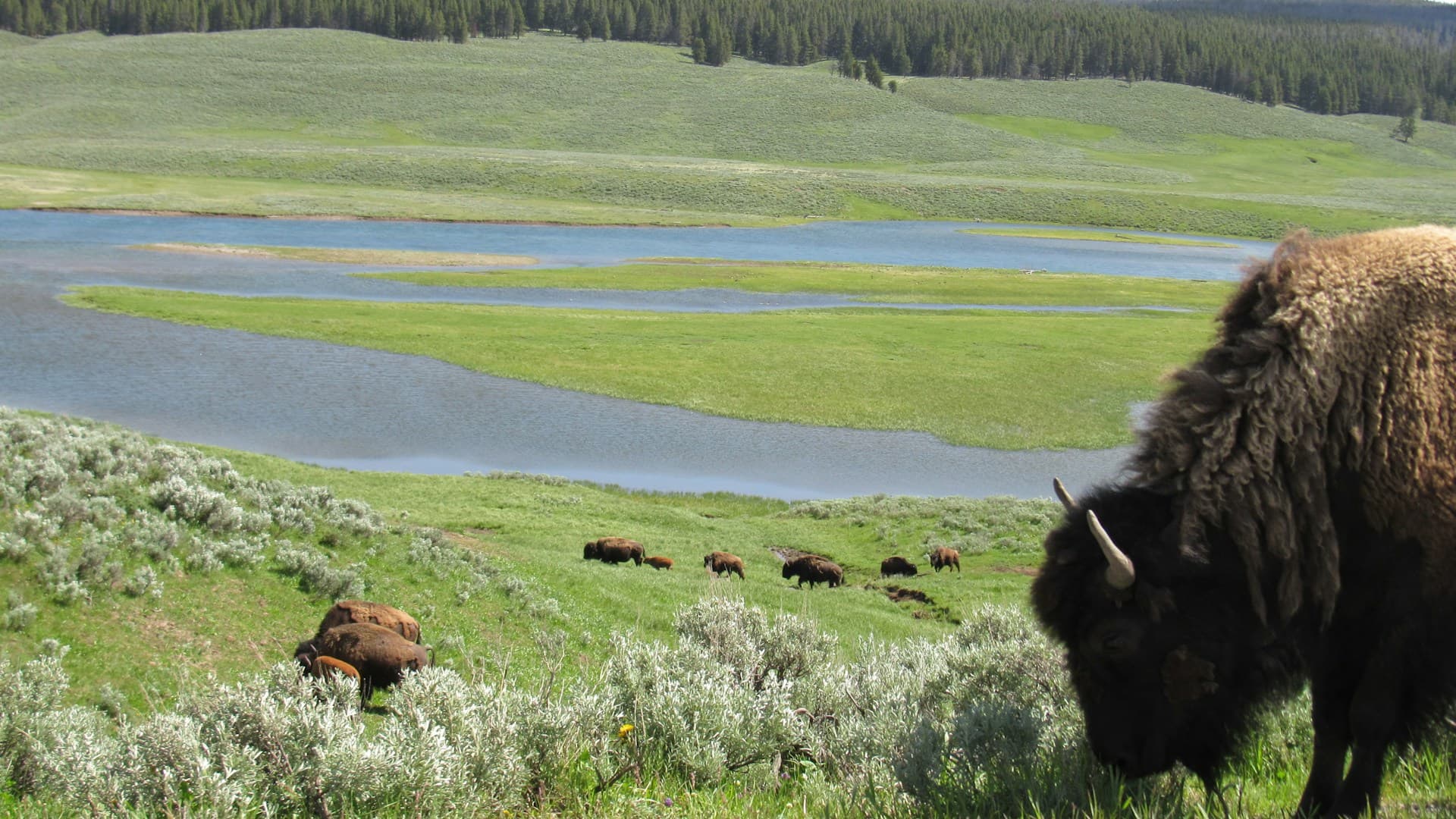
The recovery began in Yellowstone — one of the parks Theodore Roosevelt helped protect — where a remnant herd of fewer than two dozen genetically pure bison had survived in the Pelican Valley. Conservation organizations, state and federal agencies, and private ranchers cooperated to build captive and wild herds from those survivors. Today, approximately 500,000 bison exist in North America, with about 30,000 managed for conservation in public herds. The largest conservation herd roams Yellowstone National Park, representing genetically pure bison largely free from cattle DNA.
The bison is now the official National Mammal of the United States, designated by Congress in 2016. It is a national symbol that almost ceased to exist — brought back, in part, by the same conservation infrastructure that hunters and anglers built.
The Bald Eagle: from 417 nesting pairs to 316,700 individuals
America adopted the bald eagle as its national symbol in 1782, when anecdotal accounts suggested as many as 100,000 nesting pairs in the continental United States. By 1963, through habitat loss, illegal shooting, and the catastrophic effects of the pesticide DDT on eggshell production, only 417 nesting pairs were found in the lower 48 states.
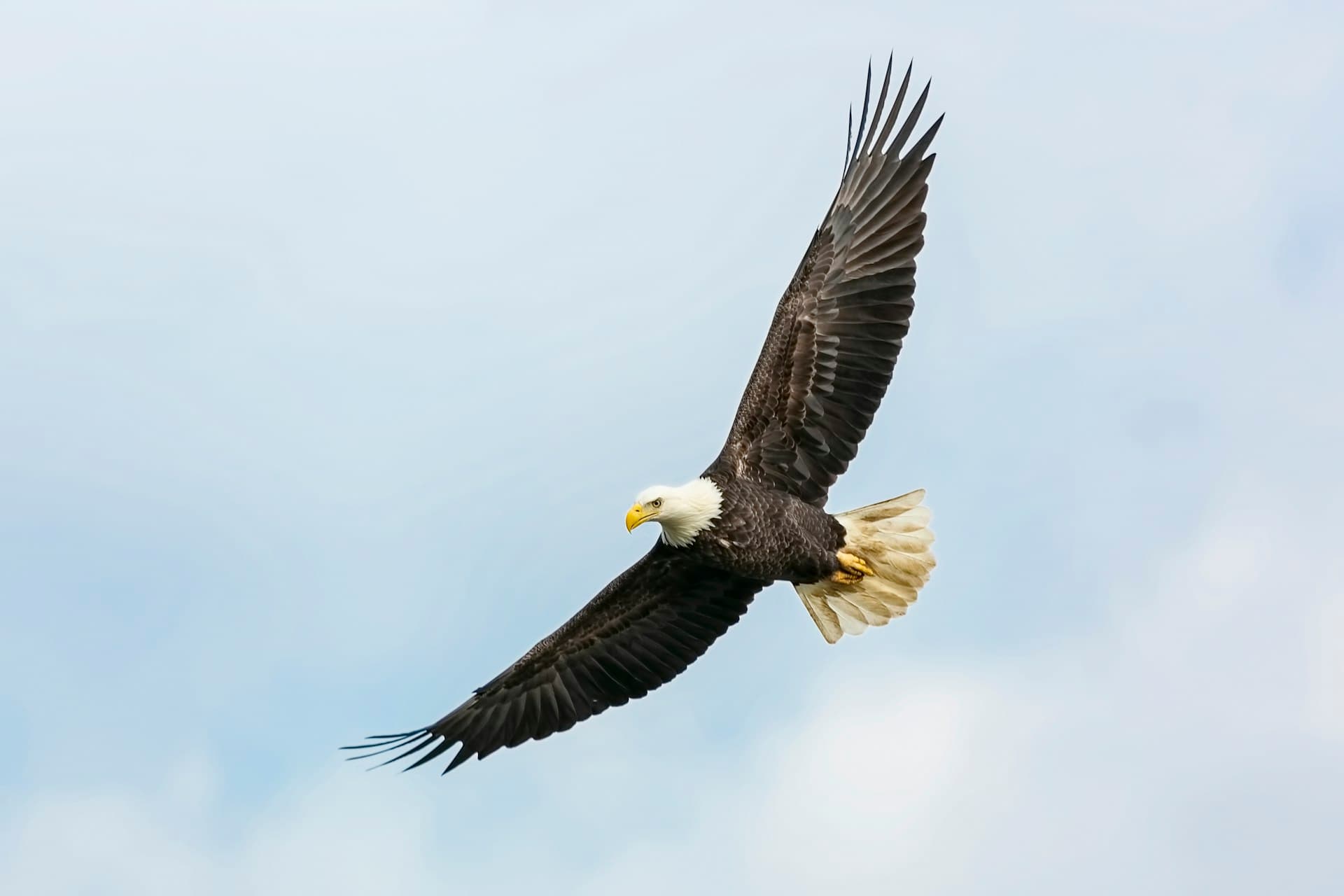
The recovery required multiple interventions: the DDT ban of 1972, Endangered Species Act protections enacted in 1973, federal and state reintroduction programs, and the habitat network — refuges, wetlands, riparian corridors — that had been built and preserved largely through hunter and angler funding over the preceding decades. Today, more than 316,700 bald eagles soar across the United States, with over 71,400 nesting pairs — an astonishing 75-fold increase since their lowest point, leading to their removal from the endangered species list in 2007.
The eagle that looked down from 417 nests in 1963 now looks down from 71,400. It soars over the National Mall on the Fourth of July, over the rivers and lakes where anglers fish, over the wetlands that Duck Stamp dollars preserved. It is the most visible symbol of what this country did right when it chose to fight for its wildlife instead of watching it disappear.
The Wood Duck: from the edge of extinction to 50,000 harvested in a single state
The wood duck story is perhaps the least-told of the major American wildlife recoveries, which is remarkable because it involves one of the most beautiful birds in North America and a conservation technique so simple that any landowner can implement it today.
By the early 1900s, wood ducks had been hunted nearly to extinction across their range. The combination of market hunting and the destruction of old-growth forest that provided their nesting cavities had collapsed the population to a fraction of its historic numbers. Federal law banned wood duck hunting entirely in 1918, where it stayed for 23 years.
The recovery came in the 1930s when biologists at Chautauqua National Wildlife Refuge in Illinois — a refuge established using conservation funding built by sportsmen — began designing and installing artificial nest boxes that mimicked the natural cavities the birds required. The box designs remain central to wood duck management across North America. Hundreds of thousands of wood duck nest boxes have now been installed by private citizens and federal agencies. Four years after the first nest boxes were installed, there were enough wood ducks for a limited hunting season to resume in 14 states.
The first year the U.S. Fish and Wildlife Service published data on the federal duck harvest, in 1961, Georgia hunters shot 4,100 wood ducks. Today around 50,000 wood ducks are harvested in Georgia alone, representing 40 percent of the state's annual waterfowl harvest.
From near extinction to 50,000 birds harvested in a single state in a single season. Wooden boxes nailed to posts. Duck Stamp money preserving the wetlands they need. Hunters limiting their own harvest until the populations could support it. That is the system working exactly as intended.
What $25.5 billion buys
Let's put the total in concrete terms, because $25.5 billion is a number that needs context.
The World Wildlife Fund's total annual budget is approximately $400 million. Greenpeace International's annual operating expenditure is around $96 million. The Sierra Club runs on roughly $65 million a year.
Hunters and anglers have contributed, through Pittman-Robertson and Dingell-Johnson alone, more than $25.5 billion to wildlife conservation since 1937. That is more than 60 times the WWF's annual budget, generated not by donors writing voluntary checks to a charity but by the automatic mechanism of every gun, every box of ammunition, every fishing rod, every reel, every lure purchased anywhere in the United States.
Add the Duck Stamp's $1.3 billion in wetland acquisition. Add the hundreds of millions generated annually through hunting and fishing licenses in all 50 states. Add the billions spent by Ducks Unlimited, the National Wild Turkey Federation, the Rocky Mountain Elk Foundation, the National Deer Association, and dozens of other hunter-funded conservation organizations on habitat acquisition and restoration. Add the economic activity generated by 15 million hunters and 40 million anglers annually, which funds the rural economies and the local political will that protects wild places from development.
The total picture is staggering. No other constituency — not environmental organizations, not government agencies, not corporate sustainability programs — comes close to matching what hunters and anglers have contributed to American conservation over the last 250 years.
The seven pillars of the North American Model
Conservation scholars formalized the principles that had guided the American approach to wildlife management into what is now called the North American Model of Wildlife Conservation, first articulated in 2001. Its seven core principles — sometimes called the Seven Sisters — are worth stating plainly on the 250th anniversary of the nation that made them possible:
Wildlife belongs to the people. Not to landowners, not to corporations, not to governments — to all citizens, held in trust by the government on their behalf.
Markets for killing wildlife are eliminated. No commercial sale of wild game, a radical departure from the European model and the direct reversal of the market hunting that nearly destroyed American wildlife.
Democratic law-making governs wildlife. Any citizen has standing to participate in developing wildlife policy, access it through the courts, and hold agencies accountable.
Wildlife can only be killed for legitimate purposes. Food, fur, personal protection, and property protection — not commercial exploitation.
Wildlife is an international resource. Migratory species require cooperation across borders, and North America has built that cooperation into its foundational law.
Science is the basis for management. Wildlife policy is made by biologists using data, not by political actors responding to constituent pressure.
Hunting and fishing are democratic rights. Every citizen has an equal opportunity to participate, regardless of wealth or status — a direct inversion of the European aristocratic model.
These principles are not abstractions. They are the operating system for the wildlife management structure that produced the comebacks described above. They are the reason the whitetail graze in 50 states, the turkey gobbles in 49, the eagle soars over 316,000 nests, and the bison walks again in Yellowstone.
The road ahead
This is not purely a story of triumph. There are genuine threats to the system that built America's wildlife abundance, and they deserve honest acknowledgment.
Hunting and fishing participation rates have declined over the past three decades. As the American population has urbanized, the share of Americans who hunt has fallen from approximately 7 percent in the 1990s to around 4 percent today — and with it, the license revenues and excise tax contributions that fund state wildlife agencies. The Pittman-Robertson system, brilliant as it is, was designed for a nation with a larger hunting population than America currently maintains. Finding ways to broaden the funding base — through license purchasing by non-hunters, through dedicated federal conservation funding mechanisms, through hunter recruitment and retention programs — is the central conservation challenge of the next generation.
Public land access is under sustained pressure from development, consolidation, and legal ambiguity around corner crossing and landlocked parcels. The wildlife refuges, national forests, and state wildlife management areas that provide critical habitat and public hunting opportunity are not permanent by default — they require active political defense and sustained funding to maintain.
CWD is moving through white-tailed deer, mule deer, elk, and moose populations in ways that threaten to undo decades of restoration work. The same species whose comeback is one of the great conservation success stories of the 20th century faces a disease threat that science has not yet found a reliable management tool for.
And in Oregon, right now, an initiative petition is attempting to remove the legal exemptions that allow hunting and fishing to exist — a direct attack on the funding system that maintains the wildlife abundance described in this article. That fight is not metaphorical. Read our coverage of Oregon IP28 for what is at stake if the measure qualifies for the November ballot.
The conservation system that hunters and anglers built is worth defending because the alternative is not a gentler, more compassionate relationship with wildlife. The alternative is the passenger pigeon. The alternative is 417 bald eagle nests. The alternative is 30,000 wild turkeys in the entire country, and a generation of wildlife scientists debating whether the species could survive.
America chose differently. Hunters and anglers made that choice with their license fees and their Duck Stamps and their excise taxes and their conservation organizations and their political engagement over 125 years. The wildlife abundance of 2026 — the deer in every state, the turkey in 49 of them, the eagle over every major river — is the return on that investment.
A note for the Fourth of July
On July 4, 2026, Americans will gather on lakeshores and riverbanks and in fields and forests from Maine to Hawaii. Some will fish. Some will hunt. Many will simply watch the wildlife that shares this continent with them — the eagles and the deer and the ducks and the turkeys that are here because somebody decided they were worth saving.
The Declaration of Independence said that the people of this nation were entitled to life, liberty, and the pursuit of happiness. For 250 years, hunters and anglers have been doing that — and in the process of pursuing their own happiness in the wild places of America, they have built and funded the system that kept those places wild.
That is worth celebrating on the 250th birthday of this country. That is worth knowing. And that is worth protecting.
Happy Fourth of July. Get outside.
Sources
- U.S. Fish and Wildlife Service. Wildlife and Sport Fish Restoration Program. fws.gov.
- Association of Fish and Wildlife Agencies. State agency funding overview. fishwildlife.org.
- Boone and Crockett Club. Conservation history. boone-crockett.org.
- Congressional Sportsmen's Foundation. Hunter and angler conservation funding. congressionalsportsmen.org.
- National Wild Turkey Federation. Turkey restoration history. nwtf.org.
- American Eagle Foundation. Bald eagle population recovery. eagles.org.
- Ducks Unlimited. Wetlands and Duck Stamp conservation. ducks.org.
- Colorado Parks and Wildlife. State wildlife management context. cpw.state.co.us.
- U.S. House of Representatives Historical Archives. Conservation legislation history. history.house.gov.
The Inside Spread covers hunting, fishing, shooting, and conservation. We donate 10% of profits to wildlife conservation. Learn more at theinsidespread.com/conservation.

Written by
Kenny Flermoen
Kenny Flermoen is the owner and CEO of The Inside Spread. Growing up in the Upper Midwest he spent most of his childhood outside—rain, snow, or shine. He writes about hunting, fishing, and conservation with a focus on public-land access, habitat, and the decisions that shape the future of America's outdoor heritage.
Comments
No comments yet. Be the first to share your thoughts.
More in conservation
BREAKING: The Forest Service Just Moved to Kill the Roadless Rule for Good. 58 Million Acres of the Best Hunting and Fishing Left in America Are on the Table.
The Forest Service proposed rescinding the 2001 Roadless Rule, putting 58 million acres of backcountry hunting and fishing habitat at risk. Comment by Sept. 21.
IP28 Is Dead — For Now. Oregon's Hunting and Fishing Ban Fell 13,000 Signatures Short. Here's What Happens Next.
Oregon IP28 failed to qualify for the November 2026 ballot after falling about 13,000 valid signatures short. Here is what happened—and why hunters say the fight is not over.
The History of Hunting in America, Part 2: Hunting and Conservation Efforts and Success
How hunters turned crisis into recovery—fair chase, the Lacey Act, Duck Stamp, Pittman-Robertson, and the species comebacks that prove regulated hunting funds conservation.
Pittman-Robertson, Licenses, and the Funding Cliff Nobody Wants to Talk About
Pittman-Robertson wildlife funding fell nearly 15% from FY2024 to FY2026. Here is how licenses and excise taxes fund state conservation—and how to strengthen the system without erasing hunters and anglers.