
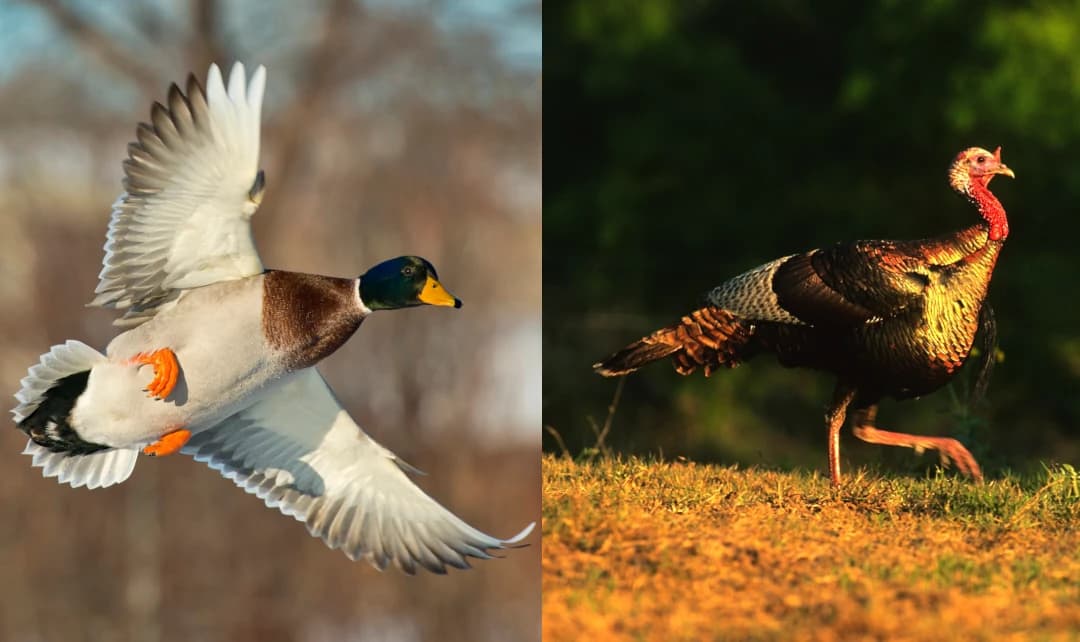
The Federal Government Just Proposed the Biggest Hunting and Fishing Expansion in History — But There's a Catch You Need to Know About
FWS proposed opening 111 refuges and hatcheries to hunting and fishing—plus rolling back non-lead ammo rules at nine East Coast refuges. What the May 2026…
Rick Mosby has been hunting waterfowl at Blackwater National Wildlife Refuge on Maryland's Eastern Shore for going on 19 years. It's a November ritual for him — the pre-dawn drive, the marsh at first light, the way the geese work the decoys when the wind is right. He knows the place the way you can only know somewhere you've returned to every year for two decades.
He also knows it's about to change.
Under a rule finalized during the Biden administration, Blackwater was set to go non-lead September 1, 2026. No more traditional lead shot. Copper and bismuth only — shot that costs anywhere from 25 to 40 percent more than the lead loads he's been running for two decades and that can be genuinely hard to find at rural sporting goods stores in rural Maryland.
Last week, the U.S. Fish and Wildlife Service proposed rolling that rule back. And in the same document, the agency announced what the Department of the Interior is calling the largest proposed expansion of hunting and fishing access in the history of the National Wildlife Refuge System.
Both of those things are true at the same time. And both deserve your full attention — especially because the public comment window closes June 26. That's 24 days from today.
What the FWS proposal actually does — the full picture
Let's put the numbers on the table before we get into the arguments, because the scale of this proposal is genuinely significant and deserves to be understood clearly.
The FWS 2026-2027 station-specific hunting and sport fishing rule, proposed May 27, 2026 under Docket No. FWS-HQ-NWRS-2026-1223, would do the following:
Open or expand hunting and fishing opportunities at 111 field stations — 107 national wildlife refuges and four national fish hatcheries — across 32 states. Create first-time hunting or fishing opportunities at 14 national wildlife refuges and three national fish hatcheries that have never before allowed public hunting or fishing. Add more than 1,450 specific hunting and fishing opportunities across the system, defined as the ability to hunt or fish a specific species at a specific location. Make more than 500 revisions and deletions to existing Code of Federal Regulations provisions to reduce regulatory burden and better align federal rules with adjacent state wildlife laws. Bring the total National Wildlife Refuge System lands available for hunting to more than 92 million acres — more than 95 percent of the entire system.
That last number is worth sitting with. Ninety-two million acres. The National Wildlife Refuge System is one of the largest public land networks on Earth, and under this proposal, nearly all of it would be open to hunting. For context, that's roughly the combined land area of Montana and Wyoming.
The Department of the Interior, under Secretary Doug Burgum, explicitly framed the proposal as advancing President Trump's Executive Order 14192 on deregulation and Secretary's Order 3447, which directs the department to remove barriers to hunting and fishing access on federal lands and better align federal regulations with state wildlife management.
FWS Director Brian Nesvik, a former Wyoming Game and Fish director who has spent his career in state wildlife management, called the proposal a continuation of the agency's commitment to expanding public access while fulfilling its conservation mission.
For hunters and anglers who have spent years watching access to federal lands erode — watching special use permits, management plans, and administrative decisions slowly shrink the footprint available for public use — this is a genuine, measurable win. More than 1,450 new opportunities at 111 locations across 32 states is not a press release talking point. It is a concrete expansion of where Americans can hunt and fish on land they own.
And then there is the catch.
The lead ammo rollback — what's actually being reversed and why it matters
Buried in the same proposed rule is a provision that has nothing to do with expanding access and everything to do with a fight that has been running in the hunting community for nearly a decade.
The FWS is proposing to rescind previously finalized nonlead ammunition, shot shell, and tackle requirements at nine national wildlife refuges. Those requirements — finalized under the Biden administration — were scheduled to take effect September 1, 2026. The nine affected refuges are:
- Patoka River NWR (Indiana)
- Great Thicket NWR (Maine/New Hampshire/Rhode Island/Connecticut/New York)
- Rachel Carson NWR (Maine)
- Blackwater NWR (Maryland)
- Eastern Neck NWR (Maryland)
- Patuxent Research Refuge (Maryland)
- Erie NWR (Pennsylvania)
- Chincoteague NWR (Virginia and Maryland)
- Wallops Island NWR (Virginia)
These are not obscure refuges. Blackwater and Chincoteague are among the most heavily used wildlife refuges on the East Coast for waterfowl hunting. Rachel Carson in Maine draws hunters from across the Northeast. Patuxent Research Refuge in Maryland is one of the most storied wildlife research facilities in the country.
The Biden-era rules were themselves the culmination of a multi-year effort that traced back to the Obama administration — specifically to a January 2017 directive issued in the final days of the Obama administration requiring the phase-out of lead ammunition and fishing tackle "to the fullest extent practicable" on all FWS lands by 2022. That directive was rescinded on Secretary Ryan Zinke's first day in office under the first Trump administration. The Biden FWS resurrected the effort on a refuge-by-refuge basis, finalizing nonlead requirements at these nine refuges after a multi-year process that included public comment periods, scientific review, and stakeholder engagement.
Now the Trump FWS is proposing to undo those finalizations before they ever take effect.
The science behind the lead debate — what it actually shows
This is where The Inside Spread is going to give you something most coverage of this issue doesn't: the honest science, from both directions.
The case against lead ammunition on wildlife refuges
Lead ammunition has been documented to cause harm to wildlife through secondary poisoning — specifically through scavenging birds that consume gut piles, unretrieved carcasses, and gut-shot fragments left in the field. The mechanism is well-established and not seriously disputed: lead rifle bullets fragment extensively on impact, leaving particles in tissue that can spread well beyond the wound channel. Birds that consume that tissue — ravens, turkey vultures, eagles, and other raptors — ingest those fragments.
The data on raptors is the strongest part of the scientific case. A study published in the journal Science in 2022 found chronic lead poisoning in nearly half of examined bald and golden eagles in North America, with ammunition fragments identified as the primary source. Lead exposure has been linked to lethargy, loss of coordination, muscle atrophy, impaired flight, and death in affected birds. Bald eagle populations in particular — a conservation success story that hunters have rightly championed — face documented ongoing lead exposure from scavenging on hunter-killed animals.
This is real. The science behind raptor lead exposure is credible, peer-reviewed, and has been reproduced across multiple studies and multiple institutions. Hunters who dismiss it entirely are not engaging honestly with the evidence.
The case against refuge-specific lead bans
The opposing argument is not that lead is harmless. It is about whether refuge-specific bans are the right policy instrument, whether the cost and availability burden falls disproportionately on working-class hunters, and whether there is meaningful evidence that refuges specifically are significant sources of lead exposure relative to the broader landscape.
The cost argument is concrete. Non-lead ammunition — primarily copper monolithic bullets and bismuth and steel shot for waterfowl applications — costs between 25 and 40 percent more than traditional lead equivalents across most rifle and shotgun calibers. For a hunter running three boxes of shells through a waterfowl season at Blackwater or Chincoteague, that premium is manageable. For a hunter on a fixed income in rural Pennsylvania who is already paying $47 for an Erie NWR permit and driving 90 miles round trip, it matters.
The availability argument is also real. Copper monolithic rifle bullets are widely available in popular calibers at major retailers. Bismuth and premium steel waterfowl loads are more consistently available than they were a decade ago. But in rural sporting goods stores — the places where hunters in the communities adjacent to these refuges actually buy ammunition — non-lead options remain significantly less stocked than traditional loads. A mandate that takes effect September 1 gives hunters in those communities very little runway to adapt.
The Sportsmen's Alliance, NRA, and National Shooting Sports Foundation have all argued that refuge-specific bans are both scientifically disproportionate — the evidence does not isolate refuges as uniquely high-risk lead deposition environments relative to adjacent private lands — and economically discriminatory against hunters with limited means. Todd Adkins, formerly of Sportsmen's Alliance, framed it this way after the 2022 finalization: agencies are "dismissive of sportsmen's concerns" while "refusing to consider alternatives" that would encourage voluntary transition rather than impose criminal penalties for using traditional ammunition.
The Wildlife Society, by contrast, supports educational and regulatory efforts to reduce wildlife lead exposure, noting that "unintentional wildlife mortalities from lead-based hunting ammunition can ultimately undermine public support for regulated hunting" — a practical conservation argument that deserves consideration beyond the politics.
Where most hunters actually land on this
The hunters who have voluntarily made the switch to copper and non-toxic loads in recent years — and there are more of them every season — generally report three things. Copper monolithic bullets perform excellently on big game, often with better weight retention and less meat damage than traditional cup-and-core lead bullets. The cost premium, while real, has narrowed as demand has increased and manufacturing has scaled. And the peace of mind of not contributing to raptor lead exposure is worth something, even to hunters who think the refuge-specific mandate is bad policy.
None of that makes the mandate the right approach. Those are two separate questions, and conflating them helps nobody.
What's also in this proposal that nobody is talking about
The lead ammo rollback dominated the initial news coverage of this proposal, but there are two other elements worth understanding.
The National Park Service parallel action
Simultaneously with the FWS proposal, the National Park Service announced it is proposing the removal of 114 localized closures and restrictions across 36 park units where hunting is already authorized by Congress. These units include national recreation areas, national seashores, and national scenic riverways — places like the Delaware Water Gap, the Ozark National Scenic Riverways, and the Cape Cod National Seashore.
This is a meaningful expansion of access in areas where hunting has often been technically authorized but practically impeded by localized closure orders that built up over decades of park management. Removing 114 of those closures in a single rulemaking represents a significant regulatory housecleaning that will open real acreage to real hunters in the eastern United States where public hunting land is scarce.
The state alignment provisions
More than 500 of the proposed revisions and deletions to existing CFR provisions are aimed at aligning federal refuge regulations with adjacent state wildlife laws. This is less glamorous than the access expansion headline, but it matters practically. Hunters who operate near refuge boundaries — who may be hunting state land adjacent to a refuge or moving between jurisdictions in a single day — have long dealt with inconsistent regulations that require them to essentially know two separate rule systems. Better alignment reduces that burden and the risk of inadvertent violations.
Why your public comment before June 26 actually matters
The public comment window on Docket No. FWS-HQ-NWRS-2026-1223 closes June 26, 2026. That is not a formality. Here is why your comment matters and how to make it count.
Federal agencies are required by the Administrative Procedure Act to consider and respond to substantive public comments received during rulemaking. A substantive comment is one that provides specific, factual information or reasoned argument about the rule — not a form letter, not a one-line expression of support or opposition, but an actual statement of your experience, expertise, or principled position.
Comments that the agency must specifically address include: documented evidence of how the access expansions affect your hunting or fishing activity, specific concerns about lead ammunition availability and cost in your region, information about non-lead ammunition performance or access challenges, or substantive arguments about the conservation science underlying the lead rollback.
What the agency does not have to address: form letters submitted in bulk by advocacy organizations, comments that express a position without providing supporting information, and comments that are duplicative of other comments without adding new information.
How to submit a comment that actually gets read:
Go to regulations.gov and search for Docket No. FWS-HQ-NWRS-2026-1223. Click "Comment." Write your comment as a specific, factual statement. If you hunt at one of the nine affected refuges, say which one, how long you've hunted there, and what the lead ammo rollback specifically means for your hunting practice. If you support the access expansion, identify which refuge or hatchery matters to you and why. If you have experience with non-lead ammunition — positive or negative — document it specifically. Submit before 11:59 p.m. Eastern on June 26, 2026.
A well-documented comment from a hunter with years of experience at Blackwater or Erie carries more regulatory weight than 10,000 form letters. The agency is legally required to engage with it.
The bigger picture: what this proposal tells us about where refuge management is heading
The FWS 2026-2027 proposal is not an isolated event. It is the clearest signal yet of the direction the current administration intends to take federal wildlife refuge management — toward maximum compatible public access, reduced regulatory burden, and alignment with state wildlife management frameworks rather than independent federal conservation policy.
Secretary's Order 3447, which this proposal explicitly implements, directs every Interior bureau to identify and remove barriers to hunting and fishing access—the same directive driving the National Park Service hunting review we covered in May. The FWS is not just complying with that order — it is leading on it. The scale of this proposal, 1,450 opportunities across 111 stations in a single rulemaking cycle, is without precedent in the agency's history.
That trajectory will continue. Future rulemaking cycles will almost certainly expand access further, continue to revisit lead ammunition and tackle requirements on additional refuges, and push the compatibility determinations that govern what activities are permitted at each refuge toward more permissive interpretations.
For hunters and anglers, this creates both opportunity and obligation. The opportunity is access — more land, more species, more seasons, closer to home, on land you already own. The obligation is stewardship. The compatibility standard that governs refuge hunting and fishing exists because refuges were created for wildlife conservation first and public recreation second. Expanded access that is conducted responsibly — following the science on lead where the evidence is strongest, supporting the funding mechanisms that maintain refuge habitat, and engaging in the rulemaking process constructively — protects the access expansion from the reversal that would inevitably follow any high-profile conservation harm.
The best argument for hunting on national wildlife refuges is a hunter who leaves the refuge in better condition than they found it. That argument is available to every hunter reading this. It is worth making.
Sources
- U.S. Fish and Wildlife Service. Press release on 2026-2027 hunting and sport fishing rule (May 27, 2026). fws.gov.
- Federal Register. Docket No. FWS-HQ-NWRS-2026-1223 proposed rule. regulations.gov.
- U.S. Department of the Interior. Press release on refuge hunting and fishing expansion (May 27, 2026). doi.gov.
- GearJunkie. FWS expansion and lead rollback coverage. gearjunkie.com.
- Bowhunting.com. Refuge access and ammunition policy reporting. bowhunting.com.
- Sportsmen's Alliance. Lead mandate and sportsmen's access positions. sportsmensalliance.org.
- The Wildlife Society. Lead ammunition and wildlife mortality policy. wildlife.org.
- Outdoor Life. Federal refuge hunting and fishing rule analysis. outdoorlife.com.
- E&E News. Federal lands hunting policy reporting. eenews.net.
- Science. 2022 raptor lead exposure study. science.org.
The Inside Spread donates 10% of profits to wildlife conservation. Learn more at theinsidespread.com/conservation.

Written by
Kenny Flermoen
Kenny Flermoen is the owner and CEO of The Inside Spread. Growing up in the Upper Midwest he spent most of his childhood outside—rain, snow, or shine. He writes about hunting, fishing, and conservation with a focus on public-land access, habitat, and the decisions that shape the future of America's outdoor heritage.
Comments
No comments yet. Be the first to share your thoughts.
More in conservation
BREAKING: The Forest Service Just Moved to Kill the Roadless Rule for Good. 58 Million Acres of the Best Hunting and Fishing Left in America Are on the Table.
The Forest Service proposed rescinding the 2001 Roadless Rule, putting 58 million acres of backcountry hunting and fishing habitat at risk. Comment by Sept. 21.

IP28 Is Dead — For Now. Oregon's Hunting and Fishing Ban Fell 13,000 Signatures Short. Here's What Happens Next.
Oregon IP28 failed to qualify for the November 2026 ballot after falling about 13,000 valid signatures short. Here is what happened—and why hunters say the fight is not over.
The History of Hunting in America, Part 2: Hunting and Conservation Efforts and Success
How hunters turned crisis into recovery—fair chase, the Lacey Act, Duck Stamp, Pittman-Robertson, and the species comebacks that prove regulated hunting funds conservation.
Pittman-Robertson, Licenses, and the Funding Cliff Nobody Wants to Talk About
Pittman-Robertson wildlife funding fell nearly 15% from FY2024 to FY2026. Here is how licenses and excise taxes fund state conservation—and how to strengthen the system without erasing hunters and anglers.